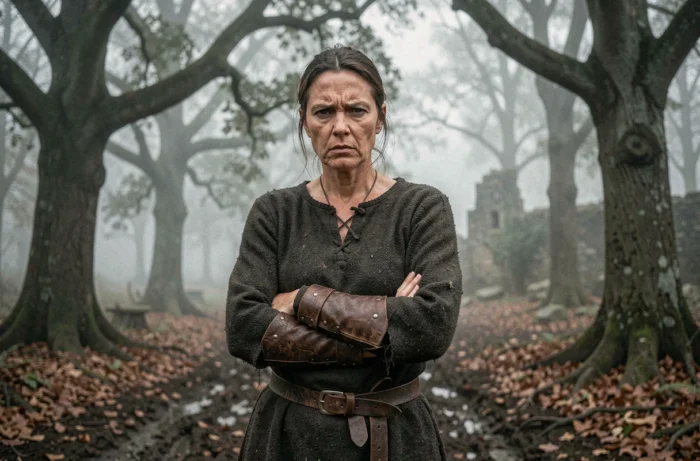
Brida and Uhtred share an identical narrative foundation: two Saxons captured as children, raised as Danes by Jarl Ragnar. This common starting point does not render their divergence anecdotal; it makes it structural. All of Brida’s anger stems from a fundamental disagreement about what this Danish upbringing means and the degree of loyalty it demands.
Brida as Uhtred’s ideological mirror in The Last Kingdom
Brida is not based on a specific historical figure. The writers constructed her as the embodiment of the path Uhtred could have taken had he chosen absolute loyalty to the Danes and Norse paganism. This is not a mere detail of writing; it is the engine of their entire conflicted relationship.
Where Uhtred navigates between two cultures, agrees to serve Alfred, negotiates with Christian lords, and composes with Saxon codes, Brida sees every compromise as an act of apostasy. For her, one is either Danish or one is not. There is no gray area.
What distinguishes this dynamic from a simple love rivalry or a political allegiance conflict is that it is based on a demand for identity purity that the series opposes to Uhtred’s fluidity. Brida accuses Uhtred not of failing but of choosing not to choose. Here we observe a classic narrative pattern of the inverted double, where the in-depth analysis of Brida’s character in The Last Kingdom highlights this dark mirror function.

The religious dimension of Brida’s anger towards Uhtred
Reducing Brida’s rage to a story of a broken heart misses the most tense spring of her arc. Her anger is primarily religious. Brida is the guardian of an uncompromising Norse paganism, and Uhtred’s proximity to Saxon Christianity constitutes for her a desecration.
Uhtred remains pagan in his personal beliefs, but he tolerates the Christian world, lives in it, and thrives. For Brida, this tolerance equates to a betrayal of the gods. Every time Uhtred serves a Christian king, every time he protects a priest or spares a church, he validates a system she wants to see destroyed.
Pagan extremism as a response to trauma
Brida radicalizes her faith in direct reaction to the violence she has suffered. Captivity, the loss of her loved ones, the slavery she endures push her towards spiritual absolutism. She interprets her suffering as a punishment from the gods for the lukewarmness of those, like Uhtred, who refuse to fully commit.
This narrative mechanism is not gratuitous. It anchors Brida’s anger in concrete experiences instead of reducing it to a whimsical character trait. Her traumas do not make her sympathetic, but they render her internal logic coherent.
Concrete betrayals attributed to Uhtred by Brida
Brida’s resentment does not build on a single event. It accumulates over several seasons through specific acts she sees as successive abandonments.
- The abandonment after Ragnar’s death: when their adoptive father is killed, Uhtred chooses to pursue his own quest for Bebbanburg rather than stay by Brida’s side to avenge Ragnar according to Danish rites.
- The refusal to free the soul of Young Ragnar: Brida expects Uhtred to participate in the ritual to allow Ragnar to access Valhalla, but Uhtred delays, caught up in his Saxon obligations, which Brida sees as an unforgivable sacrilege.
- The repeated choice to protect Saxon interests: whether it is Alfred, Edward, or Æthelflæd, Uhtred systematically places the stability of Wessex above Danish solidarity, confirming to Brida that he has changed sides.
Each episode reinforces Brida’s conviction that the Uhtred she knew with Ragnar no longer exists. She does not fight the man he has become; she mourns the one he has ceased to be.
Brida’s writing in season 4: a shift towards total antagonism
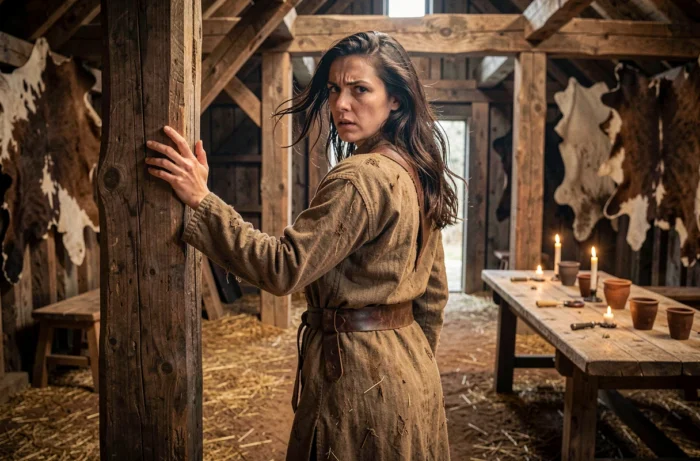
Season 4 marks a point of no return. Brida loses her last emotional anchor with Cnut’s death and shifts into outright hostility towards Uhtred. This turn is sometimes criticized by viewers as excessive, but it follows a rigorous narrative logic.
The script transforms Brida into the main antagonist precisely because she represents the ultimate consequence of refusing to compromise. Where Uhtred survives thanks to his adaptability, Brida consumes herself in her rigidity. The series uses their opposition to pose a clear narrative question: does loyalty to one’s origins justify sacrificing everything, including one’s own humanity?
A sometimes reductive treatment of the character
We observe that the series progressively simplifies Brida. In the early seasons, she is a complex, funny, strategic warrior. From season 4 onwards, her writing tightens around rage and vengeance. This reduction does not invalidate the character’s motivations, but it impoverishes her emotional palette.
The novel Warriors of the Storm, which the series loosely draws from, offers more nuance in Brida’s journey. The television version compresses entire arcs into a few scenes, which sometimes gives the impression of disproportionate anger when it is based on years of accumulated resentment.
Brida remains one of the most polarizing characters in The Last Kingdom because she embodies a radical refusal that the series neither fully condemns nor celebrates. Her anger towards Uhtred is not that of a wounded ex-lover. It is that of a believer who sees an apostate thriving in the world she fights against. This reading significantly changes how we perceive their confrontations, from season 2 to the resolution of season 5.