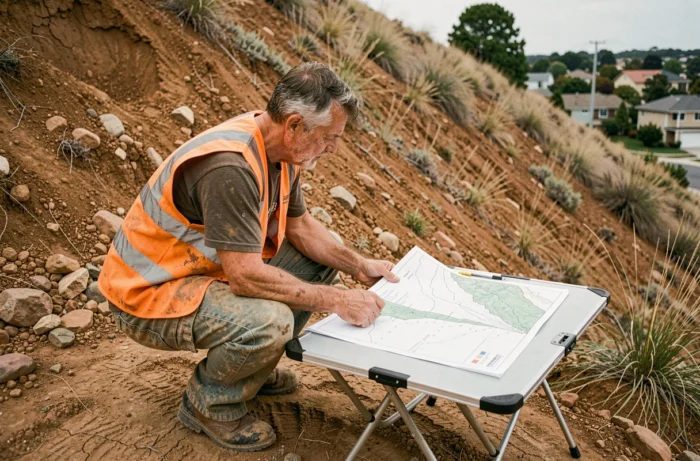
Earthworks on a sloped terrain refers to all operations of excavation, backfilling, and leveling necessary to create a stable foundation before any construction. On an inclined plot, these tasks require more machinery, time, and technical expertise than on flat land, which directly impacts the overall project budget.
Geotechnical Study G2 AVP: The Expense Item That Precedes Earthworks
Even before bringing in an excavator, a sloped terrain requires a precise analysis of the subsoil. The G2 AVP type geotechnical study is used to size retaining structures, assess soil stability, and define the appropriate drainage system.
This diagnosis also conditions the obtaining of the construction damage insurance, which becomes difficult to subscribe to without a geotechnical report on a sloped terrain. Even outside clay areas where soil study is legally mandatory, the G2 AVP remains almost necessary as soon as the slope exceeds a few percentages.
The cost of this study represents a modest fraction of the total budget, but its absence can lead to foundation repairs or much more costly damages. Including this item from the initial estimate avoids unpleasant surprises during the construction process. To delve into price ranges and technical variables, the Encore Le Printemps guide for earthworks details the different scenarios based on soil type and degree of inclination.
Cost Items for Earthworks on Slopes: Excavation, Retaining Walls, and Earth Removal
The earthworks budget on an inclined terrain is broken down into several distinct lines, each of which can vary significantly depending on the site configuration.
Excavation and Backfilling
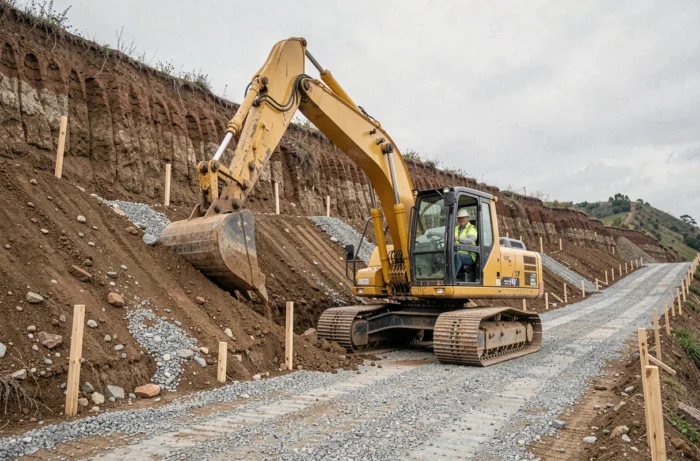
The volume of earth to be moved depends on the slope angle and the area to be leveled. The steeper the slope, the greater the excavation. When the excavated earth cannot be reused as backfill on-site (insufficient quality, excess volume), its removal to an approved storage center must be planned.
The removal of excess earth can double the cost of the earthworks item compared to a project where the excavation is entirely reused. The rate depends on the volume, distance to the disposal site, and the nature of the materials (topsoil, rock, clay).
Retaining Walls and Rockfill
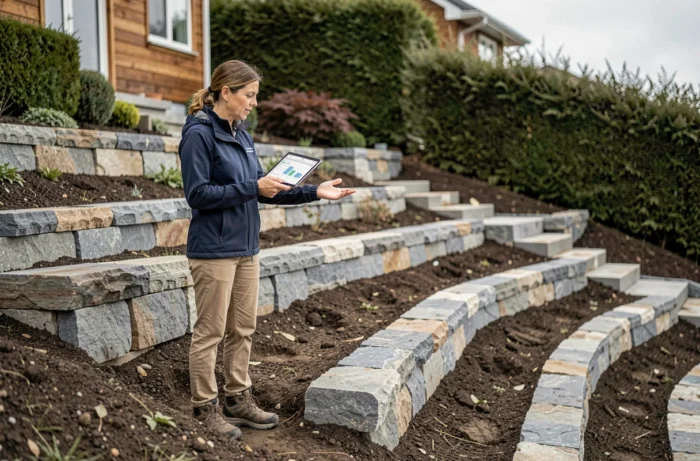
On steep slopes, a simple embankment is not enough to hold back the earth. The construction of a retaining wall or the installation of rockfill becomes necessary. These structures often represent the heaviest item in the budget, sometimes even more than the earthworks themselves.
The choice between reinforced concrete, gabions, or natural rockfill depends on the height to be supported, the nature of the soil, and the aesthetic constraints of the local urban planning scheme.
Site Accessibility
A sloped terrain complicates access for construction machinery. Creating a temporary track, widening an existing path, or transporting materials using specific means generates additional costs. This parameter is often underestimated in initial quotes.
Drainage and Administrative Compliance: Two Often Overlooked Budgets
Earthworks do not stop at leveling the ground. Two complementary items increase the budget on a sloped terrain without always appearing in the initial quote from the earthworks contractor.
Drainage Network
A sloped terrain concentrates runoff water towards the low points of the land and, potentially, towards the foundations of the future construction. The installation of peripheral drains, inspection chambers, and an appropriate outlet protects the building from infiltration. This item directly depends on the volume of water to be managed, which is linked to the surface area of the land, local rainfall, and the permeability of the soil identified during the geotechnical study.
In certain configurations, a lifting pump is added to the system when gravity drainage of the water is not possible. Its purchase, installation, and annual maintenance costs should be included in the budget.
Urban Planning Obligations Related to the Slope
A rarely anticipated point concerns elevated or pedestal terraces, common on sloped terrains. Unlike a ground-level terrace, an elevated terrace may require a prior declaration or a building permit depending on its surface area and the local regulatory context. A refusal or modification imposed by the town hall leads to additional earthworks and direct extra costs.
The local urban planning scheme also sets rules regarding height, placement, and stormwater management that influence the layout of the earthworks. Consulting the PLU before finalizing the project avoids having to redo work that has already begun.
Obtaining a Realistic Quote for Earthworks on Slopes
Comparing quotes for this type of project goes beyond the price per square meter displayed. Several elements must be explicitly included in each proposal to allow for reliable comparison:
- The planned volume of excavation and backfilling, with the calculation method used (topographic survey or visual estimation)
- The cost of removing excess earth, distinguishing loading, transport, and disposal
- The nature and sizing of the retaining structures, with the type of material chosen
- The drainage work included or excluded from the quote, and any mention of a lifting pump
- The conditions of access to the site and any preparatory work (track, clearing, tree removal)
A quote that does not detail these items likely conceals future amendments. Requesting at least three proposals from companies with documented experience on sloped sites remains the most reliable method to frame the budget.
Earthworks on sloped terrain remain a project where every meter of elevation alters the financial equation. The geotechnical study, drainage, and urban planning constraints weigh as much as the volume of earth moved. An estimate that incorporates these items from the outset provides a realistic view of the total cost, whereas a partial quote merely postpones the expense.