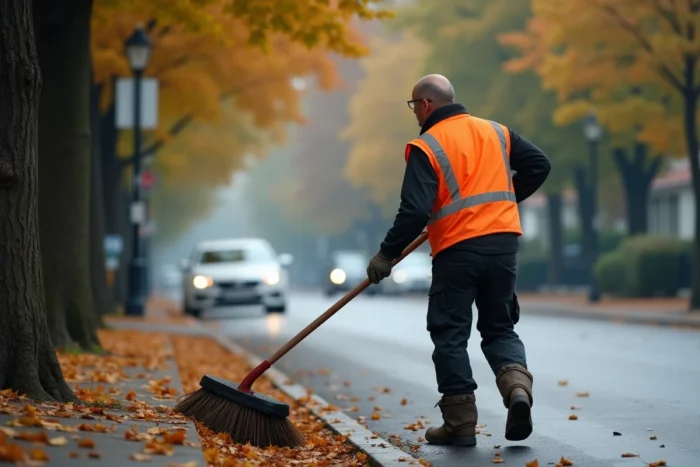
A dead leaf stuck in a gutter, a pile of gravel after a construction site, mud accumulated on a sidewalk after a downpour: street sweeping is only noticeable when it is not done. The distribution of roles between the municipality, intercommunalities, and the department creates situations where no one knows exactly who should take the broom.
Municipal, departmental, intercommunal roads: who manages what
The basic principle is simple: each road manager is responsible for the maintenance of their own roads. For municipal roads, it is the municipality that bears the burden. The maintenance expenses for municipal roads are among the mandatory expenses of municipalities.
On a departmental road that crosses an urban area, the situation becomes more complicated. The maintenance of the roadway, including its dependencies (gutters, sidewalks), remains the responsibility of the department, as stated in Article L.131-2 of the road code. The mayor, on the other hand, enforces traffic regulations and ensures safe passage. Thus, there are two distinct authorities on the same road, which regularly generates friction on the ground.
The organization of street sweeping in a municipality also depends on the status of the intercommunality. Urban communities and metropolises exercise road competence by right. Communities of municipalities and agglomerations can exercise it optionally, provided they define a community interest. When the transfer takes place, the assets are made available to the intercommunality, which takes charge of the ongoing maintenance, including sweeping.
Municipal technical service: how sweeping is organized on a daily basis
In most small municipalities, sweeping is not a separate service. It is integrated into the multifunctional missions of the municipal technical service. The same agent can, on the same day, fill a pothole, replace a traffic sign, and sweep a market square.
Villeneuve-de-Berg, for example, explicitly states “Sweeping/Road condition” within the scope of its road management. Beaugency specifies that the city ensures the maintenance and sweeping of its roads and public spaces through municipal technical services. This direct link to the technical service reflects a reality: sweeping is treated as a component of ongoing maintenance, not as an isolated service.
Mechanized or manual sweeping: the choice depends on the terrain
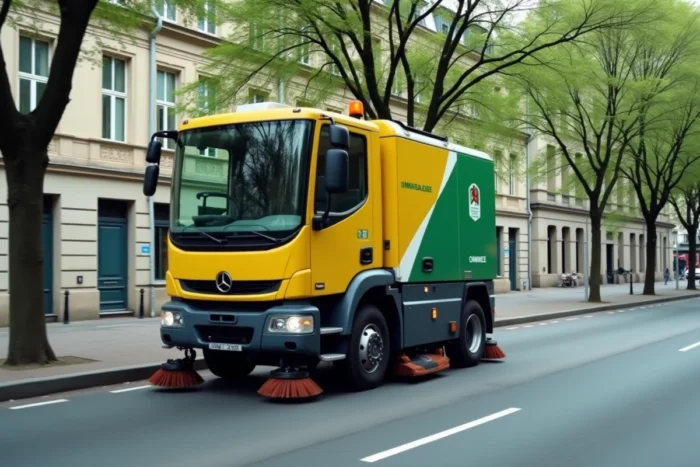
Pedestrian city centers, narrow alleys, and the surroundings of historic buildings require manual sweeping. Wider roads, parking lots, and boulevards are better suited for mechanized sweepers. In practice, most municipalities combine both methods according to the sectors and seasons.
Autumn, with the falling leaves, generates a peak in activity that often mobilizes additional staff. Sweeping covers several distinct operations:
- Mechanized sweeping of roadways and gutters, carried out according to a programmed schedule (often weekly or biweekly)
- Manual sweeping of sidewalks, squares, and the surroundings of public facilities, more frequent in city centers
- Blowing and collecting fallen leaves in autumn, which requires specific equipment
- Picking up litter (collecting papers, cigarette butts, small debris) in public spaces
Outsourcing sweeping: public contracts and specialized companies
More and more municipalities and intercommunities are outsourcing all or part of the sweeping through multi-year public contracts. The services are then divided into lots: mechanized sweeping, manual sweeping, weeding, removal of illegal dumps. Notices published on market platforms explicitly refer to the “cleaning of roads, streets, parking lots, and traffic islands.”
Onet Propreté, to name just one player, structures for the Metropolis of Lyon a bouquet of services including mechanized and manual sweeping. This type of contract allows local authorities to calibrate the frequency and intensity of cleaning according to neighborhoods, while transferring the management of personnel and equipment to the contractor.
Direct management, outsourcing, or mixed: the feedback varies
The choice between direct management and outsourcing is not obvious. Small municipalities often retain direct management for reasons of responsiveness: a municipal agent can intervene urgently after a fair or a windy episode without waiting for the scheduled visit of a contractor. Larger communities, on the other hand, often prefer to contract to benefit from heavy equipment (vacuum sweepers, high-pressure washers) that they could not amortize alone.
A mixed arrangement is common: the municipality keeps a small team for daily tasks and emergencies and entrusts heavy mechanized sweeping to an external contractor based on a contract renewed every three or four years.

Mayor’s responsibility and obligation for normal maintenance of the roads
The mayor is required to ensure a “normal” maintenance of municipal roads. This notion, established by administrative jurisprudence, means that the municipality incurs liability if a maintenance defect causes damage to a user. A slippery sidewalk due to the accumulation of un-swept fallen leaves, a blocked gutter causing localized flooding: these situations can lead to the liability of the community.
Sweeping falls within the scope of ongoing maintenance work listed in the texts. It concerns maintaining the surface qualities of the roadway, the conditions for water drainage, and restoring the accessories of the roadway. A dirty road is legally considered a poorly maintained road.
- Gravel, mud, and fallen leaves reduce grip and make the roadway slippery
- Accumulated dirt accelerates the degradation of the surface, increasing repair costs
- Blocked gutters disrupt rainwater drainage and can cause damage to adjacent properties
The budgetary allocation for sweeping varies from one municipality to another. Some include it in the road budget, others in the urban cleanliness or environmental budget. This administrative division has no impact on the mayor’s legal obligation, but it sometimes complicates the tracking of actual expenses dedicated to this mission.
Whether the municipality sweeps directly, outsources through a public contract, or transfers the competence to the intercommunality, the obligation for results remains the same. The sidewalk must be passable, the gutter must drain water. The roadway should not resemble an ice rink of fallen leaves in November.