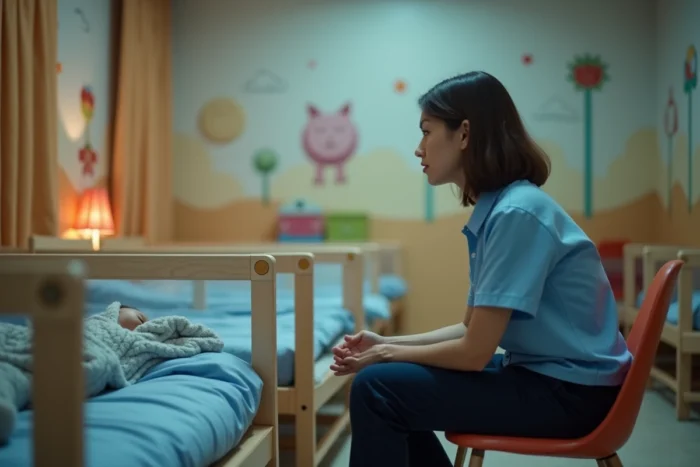
The question of whether an ATSEM can be alone in the dormitory during children’s nap time regularly arises in nursery schools. The answer depends on the applicable legal framework (school time or extracurricular time), the functional authority of the teacher, and the protocols adopted by each municipality. Comparing these two regimes allows for an assessment of the differences in responsibility that weigh on this territorial agent.
School time and extracurricular time in the dormitory: two distinct regimes
| Criterion | School time | Extracurricular time |
|---|---|---|
| Responsible authority | Teacher (school principal) | Municipality (education or extracurricular service) |
| Responsibility in case of an accident | National education (state responsibility) | Municipality (community responsibility) |
| ATSEM alone in the dormitory | Possible under the functional authority of the teacher, who remains responsible | Possible if the municipality organizes supervision |
| Main reference text | Education Code (missions of the ATSEM under the authority of the principal) | Municipal extracurricular regulations |
| Qualification of the mission | Educational and pedagogical assistance | Supervision, care |
This table highlights a point often unclear on the ground: the nature of the time determines who bears responsibility, not the physical presence of the adult in the room. An ATSEM can be alone in the dormitory in both cases, but the legal consequences of an incident differ radically.
The situation where the ATSEM alone in the dormitory supervises nap time while the teacher conducts a workshop with the awake students remains the most common configuration in nursery schools. The teacher does not disappear from the chain of responsibility, however.
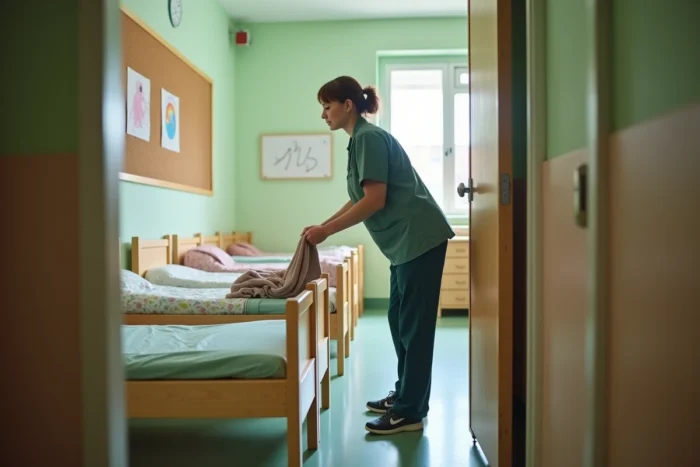
Criminal responsibility of the ATSEM during nap supervision
The penal code does not distinguish between a teacher and a territorial agent when a child is injured under the care of an adult. Anyone who has accepted the duty of supervision can be held accountable if personal fault is established (negligence, recklessness, inattention).
On the other hand, in terms of administrative responsibility, the distribution changes. During school time, it is the state that substitutes for the teacher in the event of damage caused or suffered by a student. The ATSEM, as a municipal agent, falls under the responsibility of the local authority.
This dual layer creates a gray area that several field testimonies confirm. ATSEMs find themselves alone supervising a dormitory because the teacher is engaged in another task or absent, a situation criticized as a source of insecurity and overload of responsibility, especially in large cities.
What the ATSEM cannot do alone
- Make a medical decision regarding a child showing signs of distress, without referring to the teacher or principal who holds the information of the PAI (individualized reception project)
- Change the organization of the dormitory (number of children, sleeping arrangements, wake-up times) without prior validation from the designated teacher
- Assume responsibility for nap time that overlaps with extracurricular time without a formal transfer of authority organized by the municipality
The last point constitutes a frequent blind spot. The overlap between school time and extracurricular time during nap time generates conflicts over the actual qualification of the mission: educational, care, or simple supervision.
Supervision protocols in the dormitory during heat waves
Heat wave episodes have evolved nap practices in nursery schools. Several municipalities have implemented specific internal protocols for dormitory supervision in case of high temperatures. These protocols concretely modify the conditions under which the ATSEM can be alone.
The most documented adaptations focus on three areas:
- Increased frequency of checks on sleeping children (systematic checks every few minutes instead of general distant supervision)
- Reorganization of resting areas to avoid overheated rooms, which may disperse children into several rooms and make supervision by a single adult more complex
- Limitation of the number of children per room, reducing the number of students directly under the ATSEM’s responsibility in the dormitory
Heat transforms passive supervision into active supervision, which changes the workload and the level of vigilance expected. An ATSEM alone in a dormitory at normal temperature does not perform the same work as an ATSEM alone in a dormitory over thirty degrees.

Double hierarchical authority: a blur that weighs on the dormitory
The ATSEM is hierarchically dependent on the municipality (mayor) and functionally on the teacher or school principal. This hierarchical ambivalence between municipal staff and the functional authority of the National Education is acutely manifested during nap time.
The teacher organizes nap time and decides which children sleep, at what time they are woken up, and under what conditions. The ATSEM executes these instructions. In theory, communication between the two is fluid.
On the ground, collaboration charters between municipalities and academic directions (like that of Bergerac) attempt to formalize this distribution. They specify that the ATSEM supervises the dormitory under the responsibility of the teacher, who remains reachable and intervenes in case of a problem.
When theory does not hold
The problem arises when the teacher is unreachable, when the dormitory building is separate from the main building, or when the ATSEM receives contradictory instructions simultaneously from the municipality (perform maintenance tasks during nap time) and from the teacher (focus exclusively on supervision). Some ATSEMs report being asked to cut educational materials or prepare workshops while they supervise the dormitory.
Supervising a dormitory and performing classroom work simultaneously dilutes vigilance. It is precisely in this configuration that the legal risk increases for the ATSEM, as a lapse in attention could be personally attributed to her.
Nap time in nursery schools remains a moment where legal frameworks overlap without always clarifying. The determining factor is not the presence or absence of the ATSEM alone in the dormitory, but the existence of a written protocol, validated by the municipality and the teacher, which precisely sets out the missions, means of communication, and limits of each adult’s intervention.