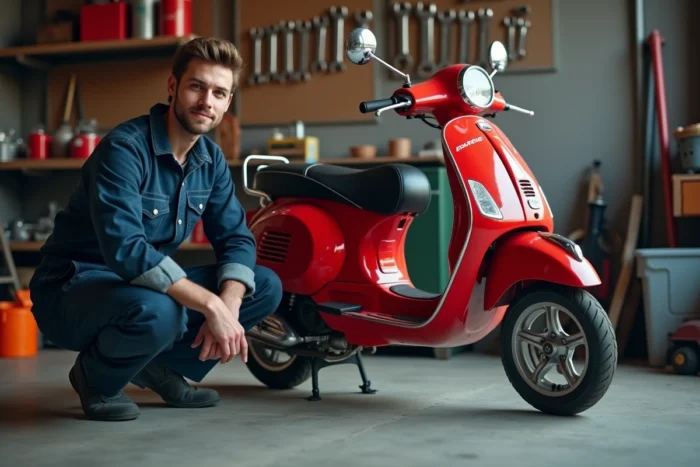
How many kilometers can a 50cc motorcycle actually travel before the engine fails? The answer varies from a few thousand to several tens of thousands of kilometers, depending on factors that owners largely control. What separates a tired 50cc with less than 10,000 km from another still vigorous beyond 30,000 km is less about the model and more about maintenance and driving habits.
Mileage Observed on 50cc Engines: Comparative Table by Engine Type
Feedback from specialized forums and manufacturer data show considerable differences depending on the engine type and the care given to the two-wheeler.
| Type of 50cc Engine | Mileage Without Major Intervention | Mileage With Rigorous Maintenance |
|---|---|---|
| Two-Stroke Air (AM6, Derbi) | About 10,000 – 15,000 km | 20,000 km and beyond |
| Two-Stroke Liquid (Minarelli) | About 15,000 – 20,000 km | Several tens of thousands of km |
| Four-Stroke (50cc Scooter) | About 20,000 km | Well beyond 30,000 km |
A Minarelli two-stroke liquid engine, mounted on several road-legal models, is designed to withstand several tens of thousands of kilometers if lubrication and routine maintenance are properly followed. Longevity depends more on the owner than on the model year: the same mechanical base, but huge differences between a well-maintained 50cc and a neglected one.
Four-stroke engines, which are more tolerant of the mixture and lubrication, generally have a longer lifespan at equivalent mileage. However, their lower power leads some riders to constantly push the engine to high revs, which negates this theoretical advantage.
To delve deeper into the issue of the lifespan and maximum mileage of a 50cc motorcycle, the type of journey matters as much as the engine type: exclusive urban use, with frequent stops and restarts, accelerates wear compared to smoother semi-rural riding.

Critical Wear Parts on a 50cc: What Fails First
The engine is not always the first part to show signs of fatigue. Several components reach their limit well before the engine itself, and late replacement can damage the rest of the mechanics.
Piston Rings and Cylinder Head
The piston rings are the most predictable wear part on a two-stroke. Mechanics report that they should be replaced around 10,000 km on a standard engine. Delaying this change leads to a loss of compression, increased oil consumption, and ultimately, cylinder seizure.
Drive Belt and Variator
On 50cc scooters with automatic transmission, the drive belt undergoes gradual stretching that degrades performance. Preventive replacement avoids a break while riding, which can lock the rear wheel.
Crankshaft and Bearings
The crankshaft and its needle bearings represent the most common heavy repair on two-strokes. Their wear manifests as a characteristic metallic noise at idle. Late replacement condemns the bottom end of the engine.
- Rings: to be monitored every 8,000 to 12,000 km depending on use, inexpensive but critical replacement for compression
- Drive Belt: regular visual inspection, replacement at the first signs of fraying or slipping
- Spark Plug: frequent change on a two-stroke, a fouled spark plug alters combustion and accelerates piston wear
- Tires: on a 50cc, tire wear is rapid in the city, and worn tires significantly increase braking distance
Technical Inspection for 50cc Since March 2026: A New Parameter
Since March 2026, 50cc motorcycles are subject to a bench test that includes a speedometer that checks the actual speed of the vehicle. This device detects derestrictions, a common practice on mopeds.
A derestricted engine runs at speeds for which it was not designed. The piston rings, crankshaft, and exhaust wear out much faster. Derestricted 50cc motorcycles rarely reach half the mileage of an original model, all else being equal.
This technical inspection changes the game for the second-hand market: a derestricted 50cc loses its compliance and may be rejected during inspection. This encourages owners to keep their motorcycle in original configuration, which, in turn, preserves the mechanics.
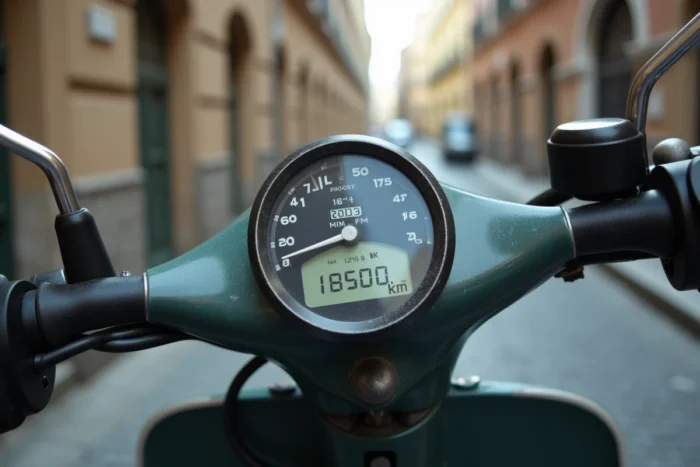
Driving and Maintenance: The Levers That Make a Difference in Mileage
Two practices separate a 50cc that exceeds 30,000 km from another that stalls at 12,000 km.
Quality of the Mixture and Lubrication
On a two-stroke, the oil/gas mixture directly conditions the lubrication of the piston and crankshaft. A mixture that is too lean scratches the cylinder. A mixture that is too rich fouls the exhaust and spark plug. Adhering to the manufacturer’s recommended ratio is the most cost-effective maintenance gesture in terms of kilometers gained.
On a four-stroke, regular oil changes play the same protective role. Degraded oil loses its lubricating properties and leaves parts in direct friction.
Driving Style and Engine RPM
Keeping the engine constantly in the red zone significantly reduces the lifespan of the entire top end. Moderate driving, with gradual acceleration after starting, reduces thermal and mechanical stress.
- Allow the engine to warm up for one to two minutes before riding, especially in cold weather, to allow the oil to circulate
- Avoid full-throttle accelerations during the first kilometers, when the parts have not yet reached their operating temperature
- Check the chain tension (or the condition of the belt) every few hundred kilometers to avoid asymmetric wear of the transmission
The takeaway from all the field feedback is simple: a well-maintained 50cc easily exceeds 30,000 km, while a neglected or derestricted motorcycle may stop before 10,000 km. The gap between the two is not due to the brand or purchase price, but to the regularity of maintenance and respect for the engine’s mechanical limits.