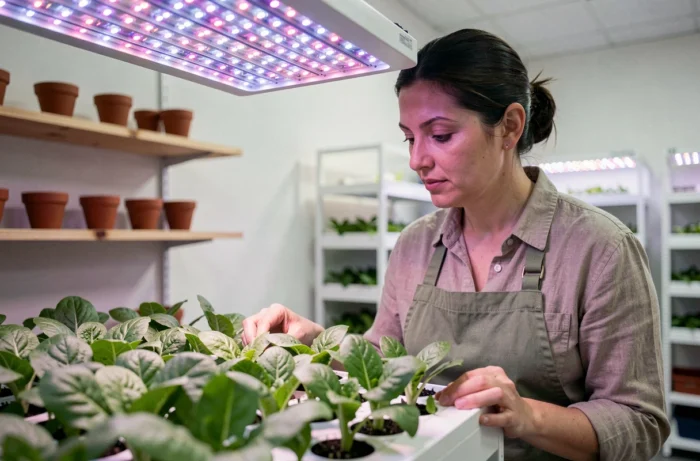
Choosing LED horticultural lighting for your plants involves balancing light spectrum, surface power, and fixture format. Three technical parameters influence the growth, flowering, and final quality of indoor crops. Comparing these criteria based on measurable data helps avoid oversized purchases or unsuitable spectra.
LED Light Spectrum and Plant Response: The Wavelengths That Matter
Most guides compare full spectrum to bi-spectrum without detailing what each band actually contributes. The table below summarizes the biological functions associated with the main wavelength ranges used in horticultural lighting.
| Spectral Range | Wavelengths | Main Function | Target Growth Phase |
|---|---|---|---|
| Blue | 400-500 nm | Photomorphogenesis, leaf compactness | Vegetative growth |
| Red | 620-680 nm | Active photosynthesis, floral induction | Flowering, fruiting |
| Far-red | 700-750 nm | Stem elongation, photosynthetic yield | End of flowering, morphological management |
| Horticultural White | Full spectrum (400-700 nm) | Complete PAR coverage, natural visual rendering | All phases |
LEDs enriched with far-red have been gaining traction since 2024. Recent research documents positive effects on photosynthesis and certain quality compounds, but also a risk of excessive stem elongation. This phenomenon, known as shade-avoidance response, necessitates precise dosing of the far-red proportion in the total spectrum.
For tropical plants or leafy vegetables, a horticultural white spectrum covering the entire PAR band (400-700 nm) remains the most versatile choice. In contrast, a flowering-oriented crop benefits from a higher red/blue ratio, possibly supplemented by controllable far-red on a separate channel.
Opting for custom LED horticultural lighting systems allows for adjusting this spectral ratio based on the cultivated species, whereas a standard panel imposes a fixed spectrum.
PPFD, PPF, and Covered Area: Metrics to Check Before Purchase
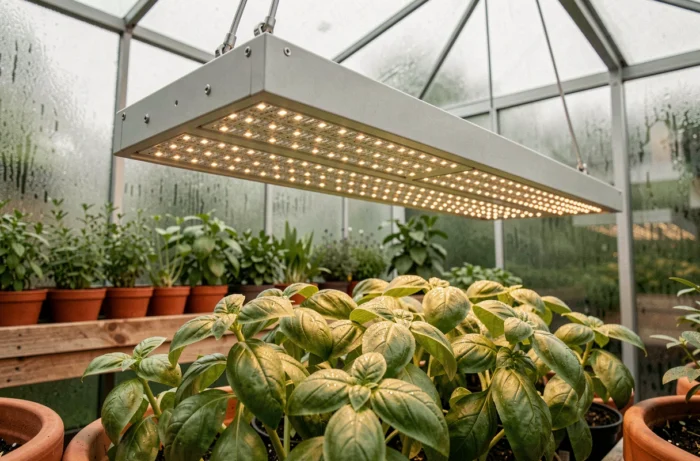
The spectrum alone is not enough. Two fixtures displaying the same spectrum can deliver radically different amounts of light at the canopy level. The metrics to compare are PPF (total photon flux emitted, in micromoles per second) and PPFD (photon flux density received by the plant), expressed in µmol/m²/s.
PPF measures what the lamp produces. PPFD measures what the plant receives at a given distance. A powerful fixture hung too high may show insufficient PPFD at leaf level. The installation distance and beam angle determine the area actually covered.
How to Use DLI to Calibrate Lighting Duration
DLI (Daily Light Integral) totals the amount of photons received over a full day. It is calculated by multiplying the average PPFD by the lighting duration, then converting to moles per square meter per day. This parameter allows for adjusting the photoperiod according to the actual needs of each species.
- Leafy vegetables (lettuce, basil) thrive well with a moderate DLI, achieved in about twelve hours under an average PPFD.
- High-demand flowering plants (tomatoes, peppers) require a significantly higher DLI, which implies either a higher PPFD or an extended photoperiod.
- Tropical houseplants (philodendrons, pothos) tolerate a low DLI and do not need high-power fixtures.
DLI avoids the classic pitfall of oversizing: buying a too-powerful panel for low-light-demand plants wastes energy and can cause leaf burn.
Photon Efficiency and Durability: What Product Sheets Don’t Always Show
The photon efficiency of an LED fixture is expressed in µmol/J (micromoles per joule). The higher this value, the more efficiently the fixture converts electricity into usable light for plants. Recent professional-grade models exceed 4 µmol/J in certain ranges, compared to significantly lower values for entry-level panels.
However, the efficiency stated on the technical sheet corresponds to laboratory conditions. Ambient temperature, heatsink quality, and diode aging affect actual performance.
Document Traceability and Compliance of Fixtures
Purchasing requirements have tightened in 2025, particularly for professional projects. Verification now focuses not only on spectrum or power but on the certified compliance of the fixture. Buyers now request accredited test reports, luminous flux maintenance sheets, and exact correspondence between the tested reference and the delivered reference.
This evolution also concerns demanding individuals. A manufacturer capable of providing these documents offers additional assurance regarding the actual lifespan and stability of the spectrum over time.
LED Fixture Format: Bars, Panels, or Bulbs Depending on the Growing Space
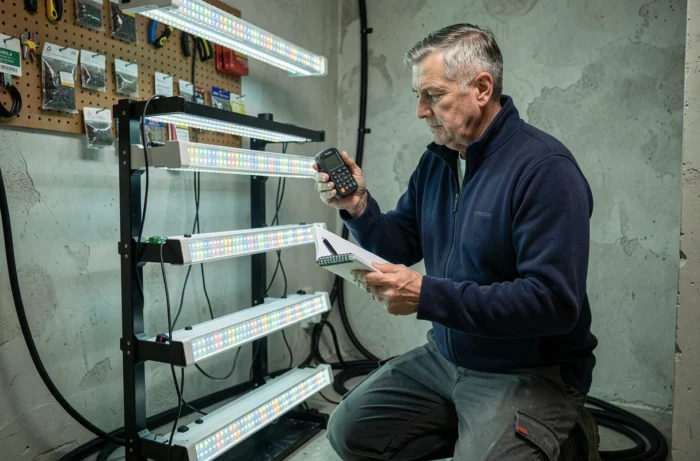
The choice of format directly depends on the physical configuration of the space. Three formats dominate the market, each suited for different uses.
- LED bars (racklight type) are suitable for shelf cultivation or vertical farming, thanks to their slim profile and ability to be mounted close to the canopy.
- Multi-bar panels cover larger areas and adapt to grow tents or dedicated rooms, with a more even light distribution.
- Horticultural LED bulbs (E27 or E40 format) fit into standard sockets for spot lighting on a few houseplants.
For an indoor growing space dedicated to vegetables, a multi-bar system with adjustable spectrum and independent channels offers the best flexibility. For a windowsill or a shelf of tropical plants, a compact LED bar suffices.
A often-overlooked parameter is thermal management. A forged or extruded aluminum fixture dissipates heat better than a plastic housing, which preserves diode efficiency over several years. The quality of the heatsink determines both the longevity of the fixture and the quality of the LEDs themselves.
Ultimately, choosing LED horticultural lighting comes down to intersecting three data points: the spectrum suited to the cultivated species, the necessary PPFD for the covered area, and the format compatible with the available space. Technical sheets tell only part of the story. The manufacturer’s traceability and the construction quality of the fixture determine whether the claimed performance will hold up over time.