
Following a live match from your phone, finding the results of the latest F1 Grand Prix between two meetings, or reading a tactical analysis on Sunday night: the habits of consuming sports news have changed profoundly. Sources have multiplied, formats too, and distinguishing a reliable platform from an approximate feed requires a minimum of reference points. Here’s how to navigate to access the latest sports news in real time, without any unpleasant surprises.
Real-time feeds: what distinguishes an aggregator from a sports media
You may have noticed that some sites display a score even before your TV app reports it? This delay is due to the nature of the source. A score aggregator (like a widget or results app) captures the raw data transmitted by federations or data providers. It displays the score, the scorer, the time played, but rarely the context.
A sports media, on the other hand, adds an editorial layer: analysis, quotes from the coach, tactical analysis. L’Équipe, Le Figaro Sport, or Eurosport offer commented live broadcasts where a journalist contextualizes each action. The difference is especially felt during major events like the Nations League or the Cycling World Championships.
To not miss out on summaries and analyses after a match involving the French team or a classic Ligue 1 game, checking sports news on TicTac Sport allows you to centralize multiple disciplines on one page, from football to tennis to rugby.
The choice between aggregator and media depends on the moment. During a match, the raw score is enough. After the final whistle, it’s the in-depth article that adds value. Combining both types of sources covers the entire need.
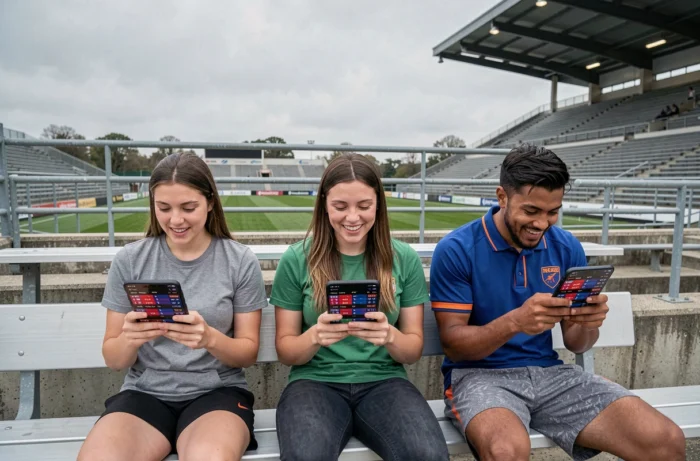
Sports news on mobile: notifications, podcasts, and personalized alerts
The majority of sports news consultations now take place on smartphones. Each sports media app offers push notifications, but not all are created equal.
Setting alerts to avoid noise
Receiving a notification for every transfer rumor in Ligue 1, every Premier League result, and every statement from the FFF can quickly saturate your screen. Most apps allow you to select specific teams or competitions.
- On the L’Équipe or Eurosport apps, you can follow only the Blues of Zinédine Zidane, a Ligue 1 club, or road cycling without being overwhelmed by the rest
- Portals like Orange Sport or Google News automatically aggregate topics based on your reading history, which sometimes creates a bubble that is too closed
- Sports podcasts (available on classic audio platforms) offer a different format: a summary of the day in ten minutes, ideal for commuting
Personalizing your sources helps avoid missing an important result while filtering out the superfluous. The setup takes two minutes and changes the quality of daily tracking.
Hacking and illegal streaming: the trap of “free” real-time
Searching for a live match on a search engine sometimes leads to unauthorized streaming feeds. Since the start of the school year, the French framework has tightened in this area.
The new Arcom system against pirate streams
Arcom (the regulatory authority for audiovisual communication) has implemented a mechanism to cut off addresses broadcasting a competition during its course, and not just after reporting. This real-time intervention makes pirate sites significantly more unstable than before.
For the internet user, the consequence is direct: a free stream found randomly risks being interrupted mid-match, with the added risk of redirects to dubious pages.
Distinguishing a legal source in seconds
Three simple indicators help verify the legality of a stream:
- The site clearly displays the name of the broadcaster (DAZN, beIN Sports, Ligue 1+, Canal+) and offers subscription authentication
- The URL is stable and does not change with each championship day
- No aggressive pop-up ads open when launching the video
A legal stream never requires installing a third-party video player. If the site prompts you to do so, close the tab.

Ligue 1+ and direct league offers: a new reflex for football fans
The landscape of TV rights in France has evolved in recent seasons. The Professional Football League now offers Ligue 1+, a nearly direct offer to consumers. This type of platform changes habits: instead of going through a satellite bouquet or an operator portal, the fan accesses matches from the league’s own app.
This model is similar to what other leagues are doing around the world. For the French viewer, this means managing an additional subscription, but also smoother access to highlights, statistics, and post-match press conferences.
General media like Le Figaro Sport or L’Équipe maintain their role of analysis and perspective. They also cover less publicized disciplines (handball, volleyball, athletics) that direct league offers do not address. Multiplying sources remains the best strategy for comprehensive tracking.
Sports betting and real-time news: keeping a cool head
The 2026 World Cup highlighted the marketing pressure exerted by sports betting operators during major competitions. Addictions France denounced intense solicitation of bettors during the tournament. Real-time result notifications, combined with targeted ads for betting, create an environment where the line between information and commercial incentive becomes blurred.
Reading a sports news article on a portal that integrates betting odds into its articles does not offer the same neutrality as a media that clearly separates editorial content and advertising. Checking for a “advertisement” or “partnership” mention next to betting ads helps make the distinction.
Accessing real-time sports news has never been easier or more fragmented. Between historical media, score aggregators, direct league offers, and mobile apps, every fan profile finds its combination. The real filter remains reliability: an identified source, a legal stream, and a clear separation between information and commercial promotion.