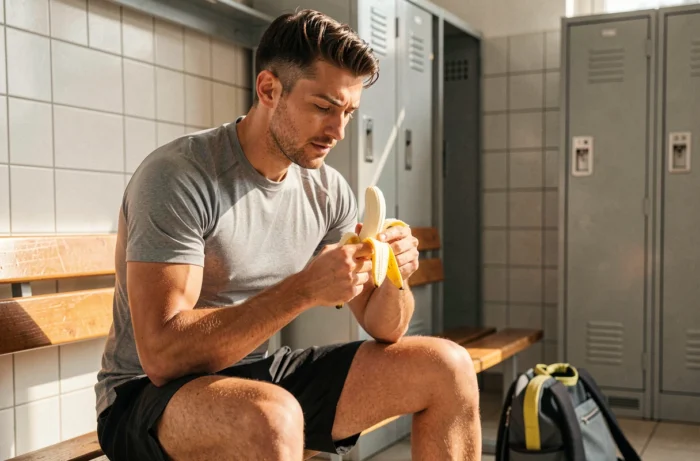
You are preparing for a long bike ride or a interval training session, and you instinctively grab a banana from the bowl. The problem is that not all bananas release their energy at the same rate. The degree of ripeness and the variety of the fruit directly affect the speed at which carbohydrates reach your muscles, digestive tolerance during exertion, and even the quality of recovery.
Banana Ripeness and Glycemic Index: The Real Lever for Sports Timing
We often talk about variety, but it is primarily the ripeness that determines the effect on the body. A still-green banana contains a high proportion of resistant starch, a complex carbohydrate that the small intestine only partially breaks down. Digestion is slow, and blood sugar rises gradually.
As the fruit ripens, this starch transforms into simple sugars (fructose, glucose, sucrose). A yellow banana with brown spots therefore releases its energy much faster. In practice, this leads to two distinct uses.
- Firm, yellow-green banana, consumed two to three hours before training: diffuse energy, little blood sugar spike, good tolerance for sensitive stomachs.
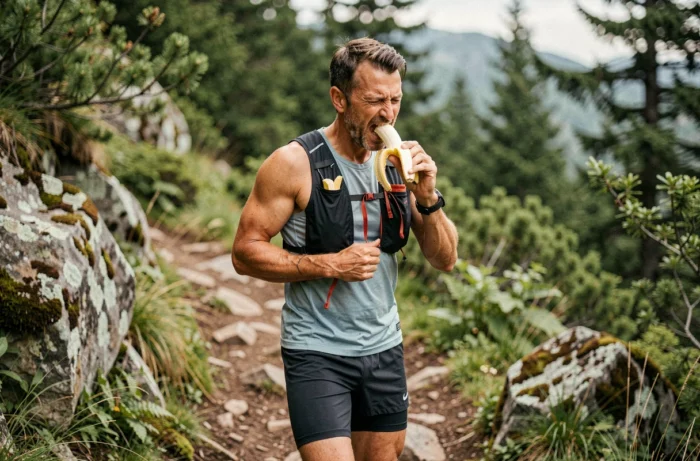
- Well-ripened banana, yellow with brown spots, consumed within thirty minutes before or during exertion: rapid availability of carbohydrates, ideal for fueling during a race or on the bike.
- Very ripe banana, almost brown, after exertion: fast sugars accelerate the replenishment of muscle glycogen, and potassium helps compensate for losses due to sweating.
This mechanism applies to the Cavendish found everywhere in supermarkets, but it also applies to other dessert varieties. The rule remains the same: the more spotted the skin, the faster the fruit acts.
To better understand the benefits of bananas for sports, one can also look into the differences between varieties, as Cavendish is not the only option.
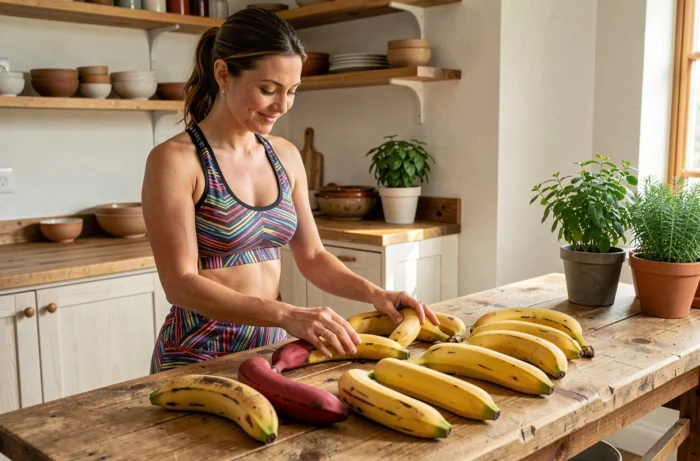
Cavendish Banana, Red Banana, Plantain: Which Variety for Which Sports Use
The Cavendish represents the overwhelming majority of bananas sold in France. Its nutritional profile is well-documented: good potassium content, vitamin B6, and carbohydrates. It is the default choice, reliable and easy to find. For most practitioners, it more than meets the needs before, during, and after exertion.
Red Banana: A Higher Beta-Carotene Content
The red banana, less common on the shelves, has carbohydrate, fiber, and potassium levels similar to Cavendish. Its uniqueness lies in a higher content of beta-carotene and vitamin A activity. This difference does not translate into a measurable acute performance gain, but it allows for a diversification of micronutrients, which can be relevant during prolonged training phases where the diet is repetitive.
Feedback varies on this point: some athletes find the red banana sweeter and more digestible, while others see no notable difference. If you find them at a market or specialty store, testing them over a week of training remains the best way to decide.
Plantain Banana: Reserved for Structured Meals
The plantain banana (and its cousins Saba or matoke) is not eaten raw. It is cooked, fried, or grilled. Its profile is closer to a starchy food than a snack fruit. In practice, it is included in a complete meal, three to four hours before a long effort, just like a serving of rice or sweet potato.
It has no value for on-the-go fueling: too dense, too slow to digest, impossible to consume without preparation. But for an athlete looking to vary their sources of complex carbohydrates daily, it is an interesting alternative on the plate.
Banana and Sports Recovery: Potassium, Electrolytes, and the Post-Effort Window
After intense exertion, the priority is twofold: replenish glycogen stores and compensate for electrolyte losses. The banana ticks both boxes. The potassium it contains helps regulate muscle contraction and fluid balance. Natural carbohydrates kickstart glycogen storage.
In practical terms, a ripe banana consumed within thirty minutes after exertion provides a carbohydrate-potassium cocktail that is hard to match with such a simple food to transport.
Practical Comparison: Choosing Your Banana According to the Timing of Effort
| Moment | Recommended Ripeness | Suitable Variety | Why |
|---|---|---|---|
| 3-4 h before effort | Green to pale yellow | Cavendish, plantain (cooked) | Resistant starch, slow energy |
| 30 min before / during | Yellow with brown spots | Cavendish, red banana | Simple sugars, rapid absorption |
| After effort | Well-ripened | Cavendish, red banana | Glycogen recharge, potassium |
| Daily meal | Variable | Plantain (cooked), Cavendish | Diversification of carbohydrates |
This table simplifies the decision, but field testing remains the best validation. Digestive tolerance varies from person to person, especially during high-intensity exertion. Start with a well-ripened Cavendish for fueling, then adjust the ripeness according to your gastric sensations.
The variety matters less than the ripeness stage and the timing of consumption. A green banana eaten five minutes before a sprint will not be helpful, regardless of its origin. Conversely, a well-spotted Cavendish slipped into a jersey pocket remains the simplest and most effective gesture to support prolonged effort.