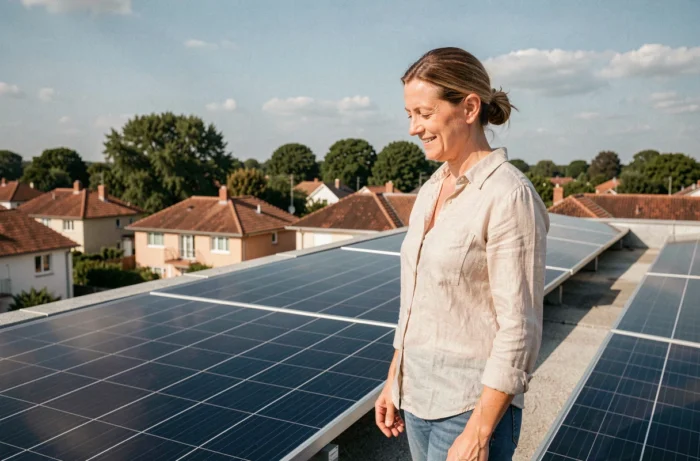
Since June 2026, the landscape of residential solar incentives in France has changed abruptly. The self-consumption bonus for installations of less than 100 kWc has been removed for all new connection requests. MaPrimeRénov’ will stop funding individual solar water heaters starting in September 2026. In this context, transforming one’s home into a source of savings through solar energy remains possible, but the levers are no longer the same as they were a year ago.
Removal of the self-consumption bonus: what it changes for a residential solar installation
The so-called “S21” reform caught part of the industry off guard. Until early June 2026, an individual who had photovoltaic panels installed for self-consumption with surplus resale benefited from a bonus paid over several years. This mechanism made the return on investment faster and financially secured hesitant households.
Since June 5, 2026, the self-consumption bonus has been removed for new requests. The economic model of a rooftop solar installation now relies almost exclusively on the electricity consumed directly by the household. The resale of surplus to the grid, whose rate remains modest, is no longer a decisive profitability argument.
Industry professionals, such as those listed on energieosolr.fr, are adapting their proposals by emphasizing the precise sizing of the installation in relation to the household’s consumption habits. An oversized system that would produce a lot of surplus becomes less interesting than a system calibrated to cover the actual needs of the home.

Solar self-consumption and usage management: the real lever for savings in 2026
The economic stakes have shifted. Producing solar electricity at home only makes strong financial sense if this electricity is consumed on-site, at the moment it is produced. Each kilowatt-hour of self-consumed electricity represents more than 20 cents in savings compared to purchasing from the grid, according to field feedback from the industry.
Increasing this self-consumption requires adapting household usage to sunlight hours. Specifically, this means running the washing machine, dishwasher, or electric water heater during the day rather than in the evening.
Smart energy management at home
Connected management systems are gaining ground in homes equipped with photovoltaic panels. These devices automatically shift certain energy-intensive appliances to solar production windows. Heating sanitary water, which represents a significant electrical consumption item, is particularly well-suited to this shift.
Battery storage remains an expensive option whose profitability is debated. Field feedback varies on this point: in regions with high sunlight, a battery can tangibly improve the self-consumption rate, but the additional investment cost lengthens the payback time. For the majority of households, smart usage management offers a better cost-effectiveness ratio than purchasing a battery.
Solar water heater: the end of MaPrimeRénov’ and its consequences
Alongside the photovoltaic reform, MaPrimeRénov’ will stop funding individual solar water heaters starting September 1, 2026. The aid will shift to enhanced CEE bonuses, which are significantly less generous. For a household considering a solar thermal system to produce hot water, the remaining cost increases significantly.
However, solar thermal still has real technical interest. A well-sized individual solar water heater covers a substantial portion of a household’s hot water needs, with mature technology and a long lifespan. The question is not one of efficiency, but of financing.
Tax credit and solar thermal
The government has extended its “green” tax credit to solar thermal, which partially compensates for the disappearance of MaPrimeRénov’ in this area. The available data does not yet allow us to conclude whether this compensation is sufficient to maintain the attractiveness of solar water heaters for middle-income households. The first feedback will be visible by the end of 2026.
Enedis connection and hidden costs of a photovoltaic installation
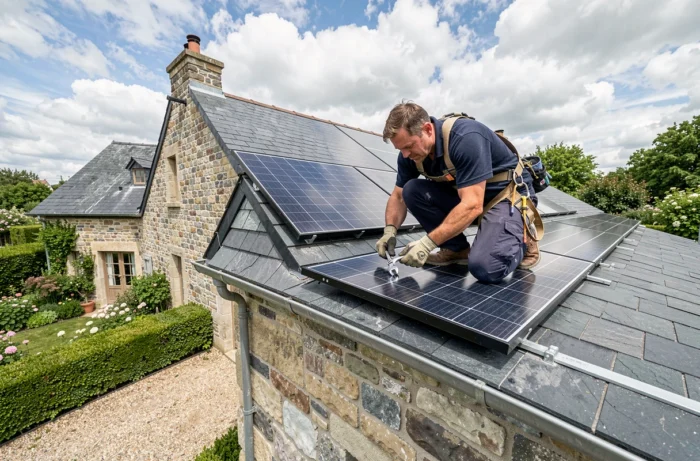
A rarely discussed point in promotional content concerns the cost of connecting to the grid. Enedis connection rates will increase starting October 28, 2026. For a residential installation with surplus injection, this increase adds to installation costs and further reduces the profitability margin of the “resale” model.
On the other hand, for households opting for total self-consumption (without injection), specific connection to the grid for resale is not necessary. This choice simplifies administrative procedures and eliminates one expense item. However, it requires particularly precise sizing of the installation, or else excess electricity produced during peak sunlight hours may be lost.
Elements to check before launching a residential solar project in 2026:
- The household’s consumption profile, hour by hour, to accurately calibrate the power of the photovoltaic panels
- The compatibility of the electrical panel and existing installation with a smart usage management system
- The real additional cost of the Enedis connection if you plan to resell surplus, taking into account the rate increase in October 2026
- Eligibility for the tax credit for solar thermal, which varies according to household income
Ecological impact of residential solar: beyond the rhetoric
Photovoltaic solar energy emits very little greenhouse gas during its operational phase. Electricity production from the sun generates neither CO₂ nor fine particles at the household level. Over the entire life cycle (manufacturing, transport, installation, recycling), the carbon footprint of a solar panel remains significantly lower than that of fossil fuels.
The recycling of end-of-life panels is progressing, driven by the regulatory obligation for manufacturers to take back used modules. Treatment sectors recover a large portion of materials (glass, aluminum, silicon). Conversely, the issue of sourcing raw materials for manufacturing remains a point of tension on a global scale, with no definitive answer at this stage.
Installing solar panels on one’s roof reduces the household’s dependence on market electricity price fluctuations. In a context where energy prices remain unstable, this partial autonomy constitutes a tangible benefit, provided one accepts that profitability now depends on the ability to consume one’s own production rather than on a system of public aid.