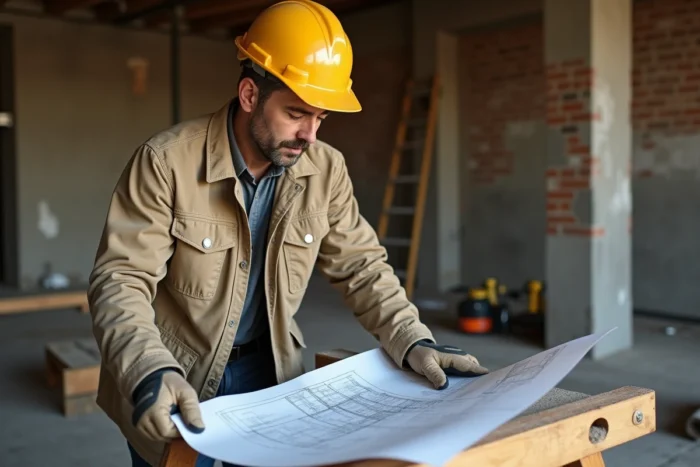
A load-bearing wall discovered in the middle of a construction site, a materials invoice that doubles between the estimate and delivery, a contractor who delays by three weeks because the previous batch fell behind. These situations almost always stem from the same problem: a renovation or construction project launched without a serious technical diagnosis. Before discussing inspiration or trends, it is this step that conditions all the rest of the work.
Technical diagnosis before the construction: what avoids cost overruns in renovation
For an old house, the first visit is not enough. You can spot tired plaster or outdated windows with the naked eye, but the real cost items are hidden behind the partitions: the state of the framework, the quality of the existing insulation, electrical compliance, presence of moisture in the buried walls.
A structural diagnosis carried out by a study office costs a few hundred euros. It allows you to know if the slab can support an overload, if the foundations have active cracks, or if the drainage system is compatible with a rearrangement of the bathroom. Without this document, the contractor’s estimate is based on assumptions.
To frame this type of preparation and identify priority items, one can rely on the work with ARTS Constructions, which details the different categories of interventions by trade.
A point often overlooked: check the compatibility between the old and the new. Installing high-performance insulation on a damp stone wall without addressing vapor migration creates a condensation problem in the medium term. The diagnosis allows for sequencing the interventions in the correct order.
Renovation budget: anticipate the rise in material costs
The share of new construction in the building activity in France has significantly decreased in recent years, reaching a low level compared to previous decades. Renovation is therefore absorbing an increasing share of demand, which drives up the order books of contractors and the prices of materials.
Construction price indices have risen sharply compared to pre-crisis levels. On an insulation or window replacement site, this is directly reflected in the estimate.
Three concrete levers to contain the budget
- Compare at least three detailed estimates, line by line, distinguishing between supply and labor. A price difference on the materials item sometimes hides a difference in quality, not a contractor’s margin.
- Contractually fix the duration of price validity. An estimate signed in March with materials delivered in July can be revised if nothing is locked in.
- Plan for a contingency envelope of around 10 to 15% of the overall budget. On a renovation site, opinions vary on this point, but going below 10% exposes you to painful trade-offs along the way.
The common reflex is to cut back on insulation or heating to save the budget. This is a poor calculation: these items condition the energy bill over ten or twenty years.
Energy renovation: the trade-offs that change the heating bill
Energy renovation represents a significant part of improvement-maintenance in France and remains the main lever to reduce a home’s consumption.
On the ground, the order of work is as important as the choice of materials. Insulating before changing the heating system allows you to size the new boiler or heat pump based on the actual needs of the insulated home, not on those of the original thermal sieve.
Prioritize items according to real gain
In a single-family home built before the 1980s, heat losses are mainly distributed between the roof, walls, and windows. Treating the roof first generally offers the best ratio between intervention cost and thermal gain.
Windows, on the other hand, represent a high unit investment for sometimes modest gains if the surrounding walls are not treated. Replacing windows without insulating the walls creates thermal bridges at the frames and supports, which limits overall efficiency.
An energy audit conducted by a certified professional allows for prioritizing these interventions. Since the implementation of the MaPrimeRénov’ scheme, this audit has indeed become mandatory to access certain aids for comprehensive renovations.

Choice of contractors and site monitoring: what makes the difference in construction
A good contractor is not recognized by their website. They are recognized by their ability to ask technical questions during the first meeting, to provide verifiable references on similar sites, and to propose a realistic rather than optimistic schedule.
Demand a current ten-year insurance certificate before signing any estimate. This is not a formality: in the event of structural defects, it is the only protection that covers the owner for ten years after acceptance.
- Check that the contractor has an RGE qualification (Recognized Guarantor of the Environment) if the project includes insulation or heating work eligible for public aid.
- Request a schedule of interventions by batch, with validation milestones. A site without a written schedule almost systematically drifts.
- Plan for weekly site visits, even short ones, to validate ongoing choices (location of outlets, height of partitions, type of finish).
On new construction projects, coordination between trades is even more critical. A delay in the structural work pushes back plumbing, which pushes back electricity, which pushes back drywall installation. Every week of delay costs in temporary rental and extension of construction damage insurance.
The temptation to manage a multi-trade site yourself to save on a project manager’s fees is understandable. On a simple project (refurbishing a room, replacing windows), it is manageable. On a heavy renovation or construction, the apparent gain is paid for in coordination errors and rework. A project manager identifies implementation discrepancies throughout the site, before corrections become costly.