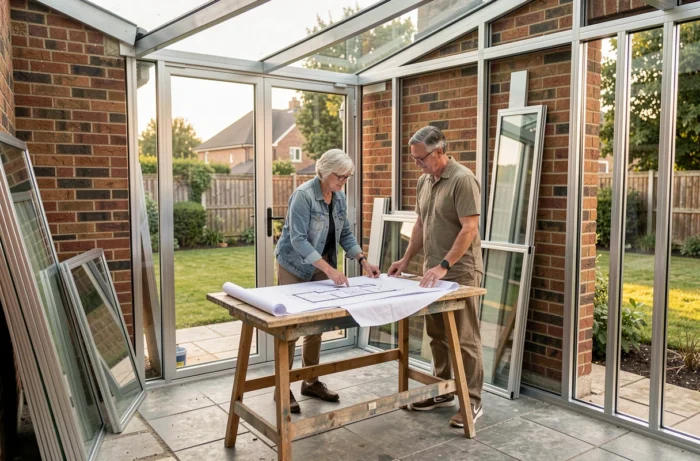
The price per m² of a veranda remains one of the major obstacles for homeowners considering a glass extension. With the regulatory adjustments planned for 2026 and the ongoing pressures on material costs, the temptation to postpone the project by a year or two seems logical. The available data do not allow for a conclusion of a mechanical decrease in prices, and several factors work in the opposite direction.
RE2020 and Veranda: A Regulatory Framework That Affects Costs
Competitors extensively detail the thresholds for prior declaration and building permits, but few address the impact of RE2020 on the actual budget of a veranda. The environmental regulations, which apply to new constructions and extensions under certain surface conditions, impose insulation and thermal performance requirements that did not exist a few years ago.
A veranda classified as a buffer space under RE2020 (unheated, separated from the living space by an insulated wall) escapes the heaviest constraints. On the other hand, if the veranda is integrated into the heated volume of the house, the requirements for glazing, airtightness, and performance of the joinery increase the cost.
For a detailed comparison of current price ranges, the file dedicated to the price per m² on Habitat Guides allows one to position their project in relation to market averages based on material and surface area.
Waiting until 2026 or 2027 will not change this regulatory logic: thermal requirements will not relax. Postponing a project does not reduce the costs associated with standards, which only become stricter year after year.
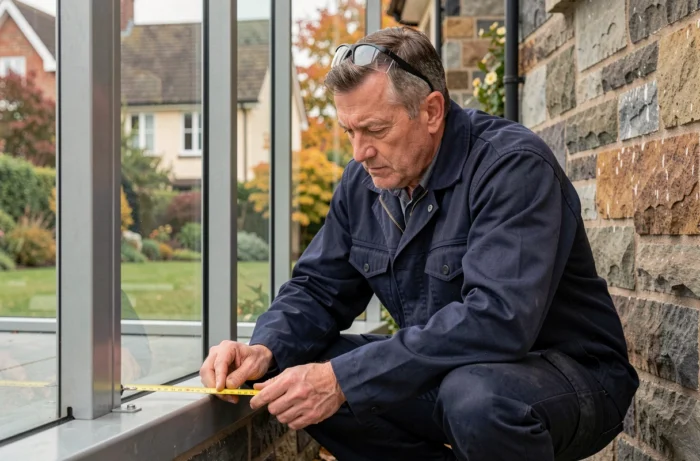
Evolution of Veranda Material Prices: Aluminum, Wood, PVC
Aluminum represents the majority of verandas installed in France. Its price directly depends on the global price of aluminum and the cost of the energy needed for its transformation. For several years, these two factors have seen significant increases, with no return to previous levels.
Wood, often presented as a warm alternative, is under the same pressures. Species suitable for outdoor use (Douglas fir, red cedar, oak) see their availability fluctuate according to European forestry policies. PVC remains the cheapest material, but its structural limitations confine it to small areas.
What Could Affect Prices in 2026
Several elements deserve attention:
- Manufacturers of “fixed-price” verandas are multiplying in the extension market, with standardized ranges that compress margins. This increased competition can drive down quotes for entry-level models.
- Aluminum veranda kits sold in large DIY stores continue to develop, although installation remains a cost that should not be underestimated.
- On the supplier side, some artisans report a stabilization of prices, while others observe occasional increases related to logistical costs.
No clear signal points to a generalized decrease in prices per m² in the short term. Possible savings are more likely to be found in choosing the model and purchasing channel than in waiting for a hypothetical market correction.
MaPrimeRénov’ and Overall Budget: The 2026 Scissors Effect
A veranda is not eligible for MaPrimeRénov’ as such. However, many homeowners combine their extension project with insulation or heating work to optimize the overall budget. It is precisely this lever that is tightening.
Since January 1, 2026, the ceilings for expenses eligible for MaPrimeRénov’ for comprehensive renovations have been lowered, and some bonuses have disappeared. Starting September 1, 2026, several isolated actions will no longer be fundable alone by MaPrimeRénov’: attic insulation, window replacement, certain water heaters, and ventilation systems must be part of a large-scale renovation aimed at achieving at least two classes of energy performance.
For a homeowner who was considering taking advantage of the aids for insulating their existing roof before adding a veranda, the calculation changes. Waiting risks losing access to funding that could have reduced the total cost of the project.
The Trap of “Postponing Everything”
Postponing the veranda to also delay insulation or glazing changes creates a scissors effect: the cost of the veranda does not decrease, and aids for related work become scarcer. The overall budget of the project mechanically increases if both projects are postponed beyond September 2026.
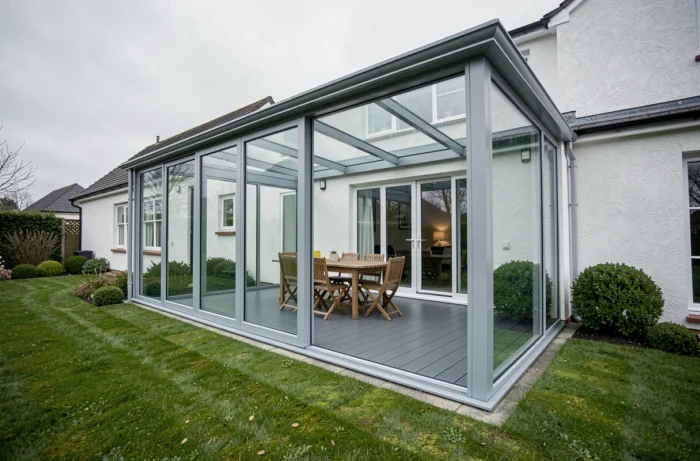
Building Your Veranda Now: Concrete Trade-offs
Rather than speculating on a hypothetical decrease, several levers allow for controlling the price per m² starting today.
The first concerns the surface area. A veranda of less than 20 m² only requires a prior declaration of work (in areas covered by a local urban plan), which reduces administrative costs and delays. Beyond that, a building permit is required, with a higher study cost.
The second lever concerns the choice between bioclimatic veranda and four-season veranda. The former, which relies on orientation and natural ventilation, costs significantly less than the latter, which is fully insulated and heated. For three-season use (office, winter garden, living space from April to October), the bioclimatic version represents significant savings.
The third trade-off concerns the structure. Hybrid verandas (wood frame and aluminum joinery) allow for combining thermal performance and slender profiles, at a cost intermediate between all-wood and all-aluminum.
Current data show no downward trajectory in material costs or labor costs. Regulatory requirements are tightening, renovation aids are refocusing, and competition among manufacturers only partially offsets these increases. A well-sized project, launched at the right time in the regulatory calendar, remains the best way to control the budget.