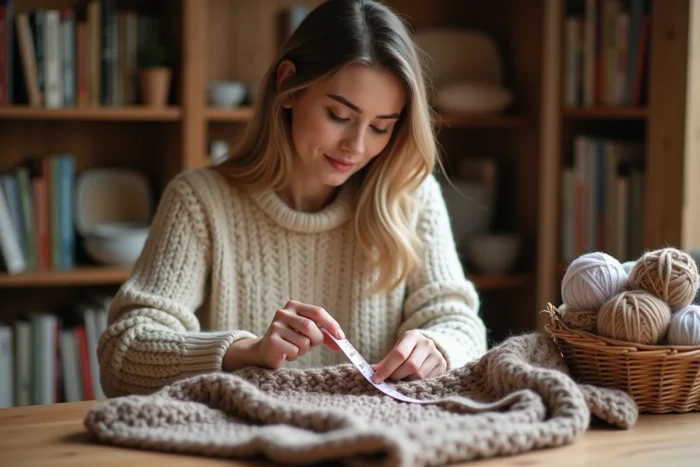
The width of a knitted scarf determines both thermal comfort and ease of wearing it daily. Between a scarf that is too narrow and rolls up on itself and one that is too wide and creates bulk under a jacket, the ideal width for a knitted scarf depends on three concrete parameters: daily use, the chosen stitch, and the type of yarn. Let’s sort it out.
Knitted Scarf Width According to Use: Commuting or Extreme Cold
The question does not arise in the same way when putting on a scarf for a city commute under a fitted jacket or when bundling up for a walk in negative temperatures. Use determines the width even before the choice of stitch.
For daily commutes, a width of about 15 to 20 cm is sufficient. The scarf fits under a coat collar without creating bulk, ties easily, and stays in place. This is the format found in most classic models for beginners.
For a wrap-around scarf intended for extreme cold, one typically goes for a width of 30 to 40 cm. This format covers the shoulders, allows for multiple loops around the neck, and provides a real thermal barrier. The oversized models that have been popular for a few seasons even reach around 55 cm, but then we enter a territory close to shawls.
To find out what the ideal width for a knitted scarf is for your project, you also need to consider the recipient. Children’s scarves are significantly narrower (around 10 to 15 cm) for safety and proportion reasons, a point that generic knitting guides rarely mention.
Knitting Stitch and Actual Width: Why the Sample Changes Everything
You can cast on the same number of stitches with two different yarns and get widths that have nothing in common. The sample is the only reliable tool to predict the final width.
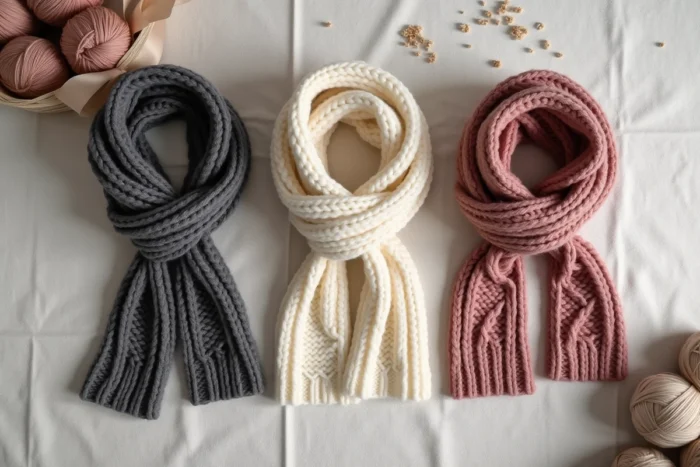
A garter stitch knitted with size 5 needles and medium weight yarn will produce a relatively dense and compact fabric. The same number of stitches in 2/2 ribbing will create a more elastic scarf, which will appear narrower when relaxed but will widen once worn.
Stitches That Influence Perceived Width
The choice of stitch not only modifies the texture but also the behavior of the knit. Stockinette stitch tends to roll at the edges, visually reducing the width and complicating the drape. Ribbing, seed stitch, or garter stitch lay flat and provide a stable width.
- Garter stitch produces a thick, reversible knit that does not roll. Suitable for scarves 15 to 25 cm wide where a clean finish without borders is desired.
- Ribbing (1/1, 2/2) creates lateral elasticity. Plan for a cast-on width slightly greater than the desired width worn, as the knit will retract.
- Seed stitch offers a good compromise between texture and flatness. The cast-on width corresponds almost exactly to the final width.
- Stockinette stitch rolls at the edges. If you want to keep this stitch, add a border of a few stitches in garter stitch or ribbing to stabilize the width.
Knitting a 10 cm sample before starting the complete project takes about twenty minutes. It is the only way to know how many stitches to cast on to achieve the desired width.
Adjusting the Number of Stitches to the Desired Width
Once the sample is completed, the calculation is straightforward. Count the number of stitches over 10 cm, then apply a rule of three to obtain the total number to cast on.
For a daily scarf of 20 cm in garter stitch with size 5 needles, you generally need around 30 to 40 stitches depending on the yarn. With a thicker yarn and size 8 needles, about fifteen stitches may suffice for the same width.
Thick Yarn or Thin Yarn: The Direct Impact on Width
Thick yarns produce a bulky knit with fewer stitches. You quickly end up with a wide scarf, but also a heavier one. For daily use under a coat, this extra weight can become cumbersome.
Medium weight yarns (about 50 g for 100 m) offer the best balance between width, weight, and knitting time. They allow for working with size 5 or 6 needles, a comfortable gauge for most knitters.
Very fine yarns (like lace or fingering) require many more rows and stitches for an equivalent width. The time to complete increases significantly, which can discourage you during the project.
Oversized Knitted Scarf or Classic Format: Deciding Based on Style
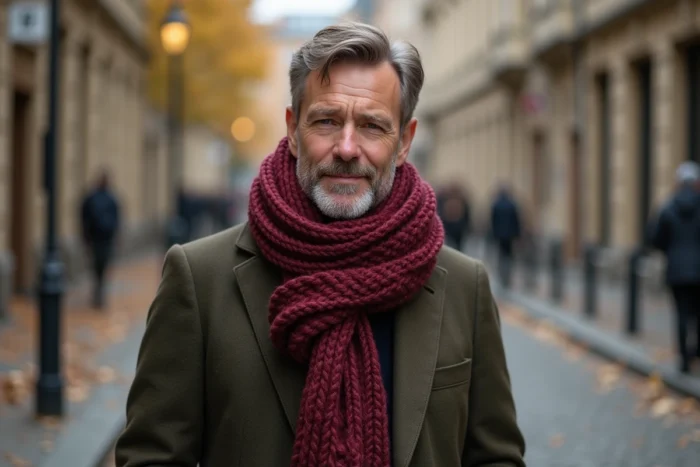
The trend for wide, enveloping scarves encourages widths of 40 cm or more. Before diving in, it’s essential to measure the desired result against your body type and wardrobe.
A scarf 45 to 55 cm wide worn unfolded functions like a mini-blanket. This format suits straight coats and silhouettes that can handle volume at the bust level. Under a puffer jacket or a fitted jacket, the result is often too bulky.
The classic format of 15 to 25 cm remains the most versatile. It can be tied in several ways (simple wrap, flat knot, tucked into the collar), fits under almost all types of jackets, and is suitable for both men and women. For a first knitting project, it’s a safe bet.
Width by Recipient: Child, Teen, Adult
Proportions matter. An adult scarf wrapped around the neck of a six-year-old drags on the ground and poses a risk of snagging. For children, keep the width under 15 cm and prefer a shorter length, or even a closed snood.
For teenagers, a width of 18 to 22 cm works well. It remains proportionate without appearing “too conservative.”
The right reflex: measure the distance from the base of the neck to the middle of the recipient’s shoulder. This measurement provides a natural reference for the maximum width of a scarf worn flat.
Choosing the width of a knitted scarf is about balancing thermal comfort, daily practicality, and visual appeal. The sample remains the starting tool, the stitch and yarn adjust the result, and the final use decides.