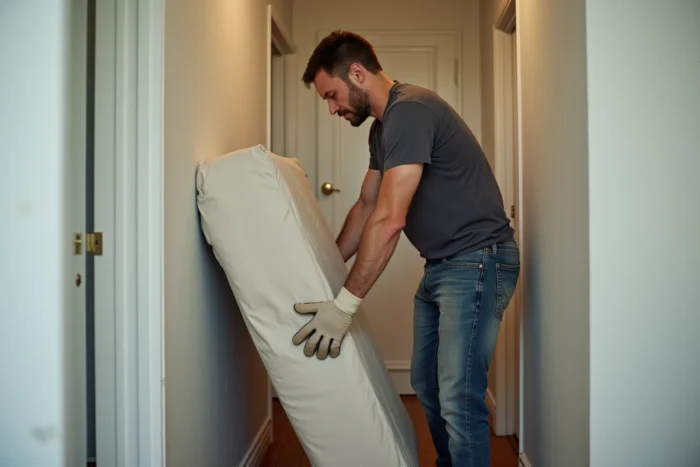
A 140×190 box spring rarely weighs less than 25 kg, and some pocket spring models exceed 35 kg. Transporting it alone without a method combines three risks: lumbar injury, damage to the frame, and damage to walls or door frames. We will detail the technical points that most moving guides overlook.
Maximum load and biomechanical limits for carrying a box spring alone
French recommendations for preventing musculoskeletal disorders advise against moving a bulky object alone that weighs more than about ten kilograms. The criterion is not only the gross weight: it is the relationship between mass, volume, and grip.
A box spring carried vertically in a hallway reduces visibility and shifts the center of gravity away from the body. The risk of falling increases as soon as the object obscures the field of vision. We always recommend a mechanical aid (dolly, flat cart) whenever you need to navigate stairs or a narrow passage.
The classic reflex is to lift by bending the knees. This is necessary but insufficient for an object of this geometry. The grip should be at the lower third of the box spring, arms extended along the frame, with the weight braced against the hip. Any twisting of the torso under load is to be avoided.
Before you start, you can consult practical advice on Immotive to assess feasibility based on your size and your housing configuration.
Dismantling the box spring: what can really be taken apart and what cannot
Not all box springs are dismantlable. Confusion on this point leads to costly mistakes on moving day.
- A slatted box spring with a bolted frame can be disassembled in a few minutes with an Allen key or a Phillips screwdriver. The stacked slats fit into a reinforced garbage bag, and the frame reduces to four flat crossbars.
- A monobloc box spring (the most common in standard bedding) cannot be dismantled. Removing the screwed feet saves a few centimeters in height, but the structure remains intact. This type poses the real problem of solo transport.
- A kit box spring (like Ikea Malm or Brimnes) can be fully dismantled. We recommend numbering each piece with masking tape and storing the screws in a zip bag taped to the main frame.
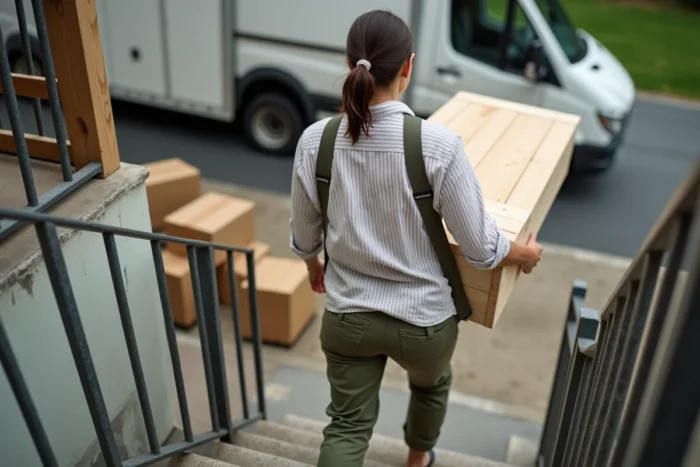
For a monobloc box spring, the only room for maneuver is protection. Wrap the box spring in a moving blanket secured with stretch film. Add cardboard or foam corner protectors on all four corners: these are the areas that absorb shocks in doorways and stairwells.
Passing through doors and stairs without external help
The standard size of a French interior door is 73 cm wide. A 140 box spring only passes diagonally or vertically. For 160, diagonal passage requires sufficient clearance on each side of the door leaf.
The most reliable technique when alone is to tilt the box spring vertically, slide it on its lower edge, and pivot in the frame while keeping the top of the box spring tilted towards you. The support foot must remain on the hinge side of the door, where the clearance is widest.
On stairs, the main risk is the tipping effect when the box spring exceeds the landing. Placing a felt pad or an old blanket under the sliding edge protects the steps and reduces friction. If the box spring hits the ceiling at the turn, it must be lowered and an angle of attack that is more horizontal attempted; never force it.
Case of spiral staircases
A 140 monobloc box spring generally does not fit in a spiral staircase with an inner diameter of less than 160 cm. In this case, the only realistic option is to pass it through the window with a lifting rope and a pulley system, which requires at least two people. Transporting a box spring alone through a window is never feasible.
Suitable vehicle and securing for damage-free transport
A standard station wagon can accommodate a 90 box spring if the back seat folds flat. Beyond that, a van is the only serious option. The usable length of a van like the Renault Kangoo or Citroën Berlingo Van rarely exceeds 180 cm on the floor: check the interior dimensions before booking.
Securing in the vehicle is as important as transporting on foot. The box spring should be stored vertically, with the upholstered side against the van wall, secured by ratchet straps attached to the tie-down rings.
- Never stack heavy objects against a vertically secured box spring: lateral pressure can deform the frame.
- Place a blanket between the box spring and the vehicle’s metal wall to prevent vibrations and scratches.
- Secure the box spring at two points (upper third and lower third) to prevent any tipping during braking.
An improperly secured box spring in a van behaves like a projectile at the first brake. Ratchet straps provide constant tension that elastic bungees do not guarantee.
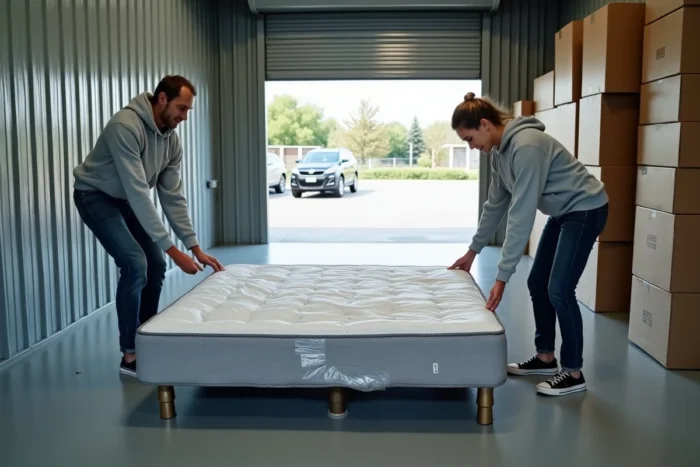
Transporting a box spring alone is feasible for a dismantlable model or a 90 cm upholstered one, provided you have a dolly and a suitable vehicle. For a monobloc model in 140 or larger, the configuration of the housing (stairs, door widths, presence of an elevator) determines everything. It is better to measure each passage before the big day than to discover halfway up the stairs that the box spring does not fit.