
You find it harder to hear the television, you ask your loved ones to repeat themselves at the restaurant, or the noise of a family gathering tires you more than before. These situations, common from the age of fifty, often indicate a gradual hearing loss. An audioprosthetist can help clarify things for you, and in Combs-la-Ville, several centers offer comprehensive support. However, it is essential to understand what actually happens during a consultation and what the 100% Santé scheme concretely changes for your budget.
What a hearing assessment in the office really measures
Before discussing devices, the audioprosthetist begins with an assessment. This is not just a simple volume test. The professional evaluates your ability to distinguish nearby sounds, understand speech in noise, and locate a sound source.
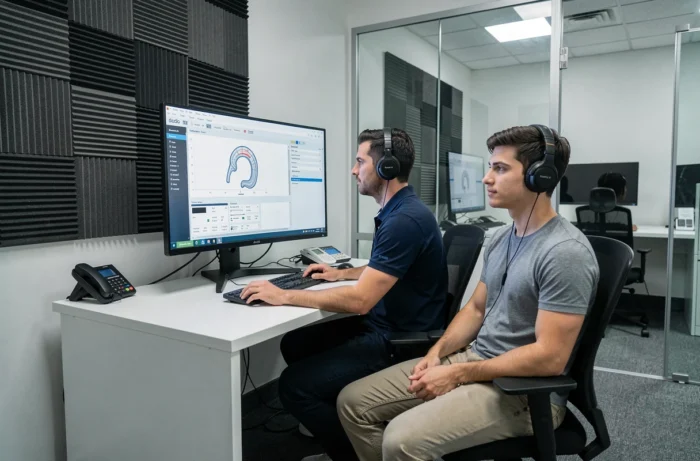
Specifically, you wear headphones in a soundproof booth. The audioprosthetist sends sounds at different frequencies and intensities, then records your responses on an audiogram. This graph becomes the identity card of your hearing: it precisely shows which frequencies you perceive poorly.
Why does this detail matter? Because two people with the same “feeling of hearing loss” can have very different profiles. One may lose the high frequencies (the consonants s, f, ch become blurred), while the other loses the mid frequencies (the human voice seems muffled). The adjustment of the device depends entirely on this profile, not on a standard model.
To obtain the advice of an audioprosthetist in Combs-la-Ville tailored to your situation, this initial assessment represents the foundation of all the support that follows. Without an accurate audiogram, no adjustment can be reliable.

Class I hearing aids: the upgrade that few patients know about
You may have heard about the 100% Santé for hearing, implemented since 2021. The principle: a device with no out-of-pocket costs with a Class I hearing aid, provided you have a medical prescription and a responsible mutual insurance. The price is capped at 950 euros per ear, fully covered.
What many do not know is that Class I devices are no longer basic entry-level models. The regulatory specifications now require at least 12 adjustment channels, an anti-feedback system, noise reduction, and several technical options defined by decree.
What does this change in daily life? A 12-channel device splits sound into 12 distinct frequency bands. The audioprosthetist can therefore adjust each band separately. If you mainly lose high frequencies, they amplify that area without affecting the low frequencies. The result: a more natural sound, less of the “tin can” sensation that older models caused.
Class I or Class II: how the audioprosthetist guides you
The main difference between Class I and Class II lies in the additional features: direct Bluetooth connectivity, artificial intelligence for adapting to ambient noise, rechargeability on certain high-end models. Class II involves a variable out-of-pocket cost depending on your mutual insurance.
The audioprosthetist is required to present you with at least one Class I option in the standardized quote. This is a regulatory obligation, not a commercial gesture. You can therefore compare the two proposals transparently before deciding.
- Class I: full coverage, minimum 12 channels, anti-feedback and noise reduction included, capped at 950 euros per ear
- Class II: advanced features (Bluetooth, AI, rechargeable), out-of-pocket costs according to mutual insurance, free pricing
- Mandatory standardized quote: the audioprosthetist must systematically include an option from each class so that you can choose with full knowledge of the facts
Follow-up with the audioprosthetist after fitting: what makes the difference over time
Buying a hearing aid is not like buying a pair of glasses. Adjustment takes several weeks, sometimes several months. Your brain must relearn to process sounds it had stopped perceiving. In the first weeks, some sounds may seem too loud or metallic.
This is where regular follow-up with your audioprosthetist makes all the difference. At each visit, the professional adjusts the settings based on your specific feedback: “I still can’t hear well on the phone,” “the background noise in the supermarket bothers me,” “my partner’s voice remains muffled.”
These follow-up appointments are included in the price of the fitting for the entire lifespan of the equipment. You do not have to pay for an additional consultation for an adjustment or cleaning.
Signals that should make you return to the center
Have you noticed that your device whistles in certain positions? Or that the sound seems less clear after a few months? These situations do not mean that the device is defective.
- A recurring whistling (feedback) often indicates a poorly fitted ear tip or a wax blockage that redirects sound to the microphone
- A gradual decrease in volume may come from a saturated wax filter, replaceable in a few seconds at the center
- A new discomfort in noise suggests that your hearing has changed and that the settings need to be updated
- Irritation of the ear canal requires a check of the size and material of the ear tip
Each follow-up visit allows for fine-tuning the settings based on the actual evolution of your hearing, not on a theoretical schedule.
ENT prescription and hearing care pathway in Combs-la-Ville
Before consulting an audioprosthetist, a medical prescription is mandatory. In practice, your general practitioner refers you to an ENT specialist who makes the diagnosis and writes the prescription. This document is valid for one year for individuals over six years old.
Without this prescription, no reimbursement is possible, whether the device is Class I or Class II. This is a point that some patients discover late, after having undergone a free assessment at a center without going through the ENT step.
In Combs-la-Ville and neighboring municipalities in Seine-et-Marne, several hearing centers offer a first free screening (non-medical test). This screening does not replace the ENT assessment, but it allows for quick detection of whether a specialized consultation is warranted. It’s a good starting point if you are still hesitant to consult.
The complete process, from the first discomfort felt to the adjusted device, generally takes a few weeks. The regularity of follow-up is as important as the initial choice of the device: a well-adjusted device over time yields significantly better results than a high-end model left with its factory settings.