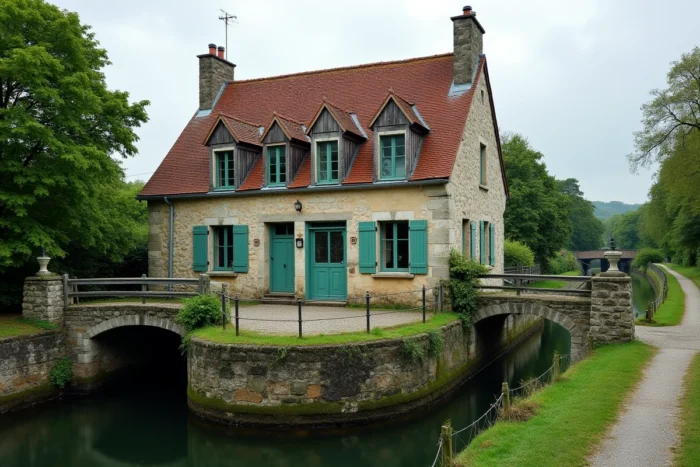
A lock keeper’s house is a building constructed along a canal, historically occupied by the agent responsible for operating the lock. In Morbihan, these stone constructions line the Blavet and the Nantes to Brest canal. Their legal particularity lies in their location on the public river domain, which radically changes the acquisition conditions compared to a traditional real estate purchase.
Land regime of lock keeper’s houses in Morbihan: regional public domain
Since the transfer of the public river domain to local authorities as part of decentralization, the Brittany Region owns the majority of the lock keeper’s houses located along the waterways of Morbihan. This transfer concerns both the buildings and their dependencies, as well as the plots on which they are situated.
This belonging to the public domain has a direct consequence: a lock keeper’s house on public domain cannot be sold according to the ordinary real estate purchase procedure. The property remains the property of the local authority. Any private occupation goes through a distinct administrative framework, the temporary occupation agreement.
To accurately identify the status of a building located in Morbihan, the first step is to consult the Brittany Region or the managing service of the waterways. Some lock keeper’s houses may have been declassified from the public domain, making them transferable. Anyone looking for a lock keeper’s house for sale in Morbihan must verify this point before any other steps, as it conditions the very nature of the project.
Temporary occupation agreement: rights and obligations of the project holder
The temporary occupation agreement (COT) is the standard legal mechanism for occupying a lock keeper’s house that remains in the public domain. It sets a fixed duration, generally between five and twenty years, and comes with specific conditions.
What the COT allows and what it imposes
The signatory obtains a right of use of the building, but not a right of ownership. They can carry out rehabilitation works, subject to obtaining the necessary authorizations from the Region and the relevant heritage and urban planning services.
In return, the agreement imposes strict obligations:
- The building must be returned in good condition at the end of the contract, including any improvements made during the occupation period.
- The intended use must correspond to the project validated during the application, often oriented towards a tourist or economic enhancement (accommodation, light catering, bike rentals, leisure activities related to the canal).
- A fee for occupation is owed to the owning local authority, the amount of which varies according to the characteristics of the property and the nature of the project.
The COT is not a commercial lease. It does not confer any right to automatic renewal or any eviction compensation at the end of the contract. This legal precariousness must be integrated from the financial setup of the project.
Calls for projects from the Brittany Region: the access channel to lock keeper’s houses
The Brittany Region regularly launches calls for projects to allocate vacant lock keeper’s houses. These procedures are aimed at public, private, or associative project holders. Morbihan, crossed by several waterways, is among the affected areas.
Selection criteria and dossier preparation
Applications are evaluated on several axes. The project must enhance the attractiveness of the canal and offer services to users of the waterway and the hiking or cycling routes that border it. A solid dossier articulates economic viability and coherence with the regional tourism strategy.
The preparation of the dossier involves detailing the proposed work program, the financing plan, the opening schedule, and the expected benefits for the territory. The Region also examines the candidate’s ability to bear the rehabilitation costs, which are often substantial for old buildings exposed to humidity and sometimes lacking compliant networks.
The application deadline varies with each call for projects. Monitoring the publications of the Brittany Region and local agglomeration communities (such as Redon Agglomeration for the southern sector of the department) remains the most reliable way to spot opportunities.
Technical constraints of rehabilitation along the canal in Morbihan
Buying or occupying a lock keeper’s house involves works whose complexity exceeds that of a classic renovation. The immediate proximity to water generates specific constraints that the budget must anticipate.
The stone walls of these old buildings often exhibit rising damp. Addressing humidity is the first technical issue to assess. The foundations, sometimes in direct contact with the groundwater linked to the canal, may require heavy repairs.
Any intervention on a building located in the public river domain requires specific authorizations, distinct from a simple building permit. The towing and footpath easements limit what can be built or modified near the bank. A fence, an extension, or even an outdoor development may be refused if they encroach on these easements.
Sanitation is also a concern. Isolated lock keeper’s houses are not always connected to the collective network. The installation of an individual sanitation system in a wet area must comply with strict rules regarding discharge and sizing, with oversight from the public non-collective sanitation service (SPANC) of the municipality.
Declassification from the public domain: the only path to a traditional sale
For a lock keeper’s house to be subject to a traditional sale, it must first be declassified from the public domain. This administrative procedure requires that the building is no longer assigned to a public service nor necessary for the operation of the waterway.
Declassification remains rare in Brittany. The Region favors making properties available through COTs, which allow it to maintain control over the river heritage. When declassification occurs, the property enters the private domain of the local authority and can then be sold, usually after an appraisal by the Domain service.
A potential buyer who wishes to become a true owner must therefore direct their search towards the rare buildings that have already been declassified, or towards lock keeper’s houses located on private plots, which occasionally exist when canals have been abandoned for a long time.
The acquisition path for a lock keeper’s house in Morbihan boils down to a clear alternative: accept the legal precariousness of a temporary occupation agreement on the regional public domain, or target the rare declassified properties that may be sold. In both cases, verifying the land status of the building with the Brittany Region is the very first step, well before visiting or estimating the cost of the works.