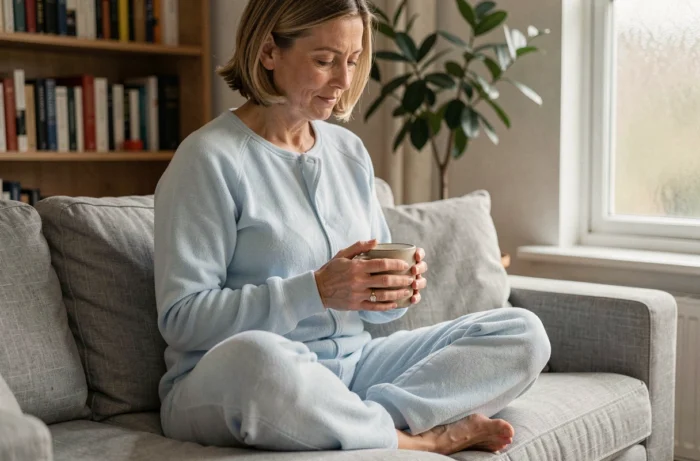
The adult onesie occupies a unique place in the medical and paramedical wardrobe. Neither a classic pajama nor a restraint device, this one-piece garment addresses specific situations: preventing undressing in disoriented individuals, maintaining incontinence protection, and providing nighttime comfort in institutions or at home.
Behind a name that evokes childhood, the adult babygro is a technical textile whose choice impacts the quality of life of the person wearing it and the daily life of those who assist them.
Ban on PFAS and adult onesies: what changes from 2026
As of January 1, 2026, France will prohibit the manufacture, import, and marketing of consumer clothing containing PFAS (per- and polyfluoroalkyl substances). Medical or paramedical onesies are directly affected: many models used water-repellent treatments or leak-proof barriers based on these fluorinated compounds.
A decree provides a twelve-month period to deplete stocks manufactured before this date. In practice, onesies containing PFAS may still circulate until the end of 2026. After this period, manufacturers must offer reformulated alternatives.
The technical problem is real. PFAS ensured durable waterproofing while maintaining a certain breathability of the fabric. Replacing them with fluorine-free coatings (based on silicone or wax, for example) raises the question of the durability of the treatment after dozens of washes. Field feedback varies on this point: some manufacturers claim equivalent performance, while caregivers in nursing homes report a faster degradation of the barrier effect on reformulated models.
For buyers (families, institutions), checking product compliance becomes a reflex to integrate. Labeling does not always explicitly mention the absence of PFAS, and no standardized pictogram exists at this stage. Requesting a technical data sheet from the supplier remains the most reliable method.
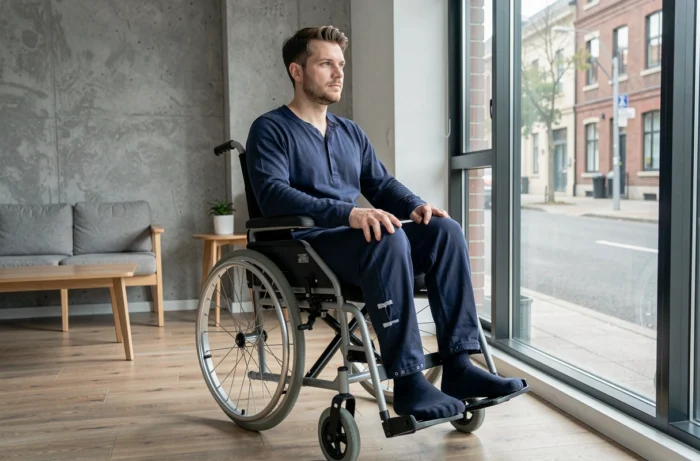
Adult babygro and digital textile passport: towards more traceability
The European regulation ESPR (EU 2024/1781) establishes a framework for the Digital Product Passport (DPP) in the textile sector. Even though its deployment is gradual, the adult babygro manufactured and sold in Europe will ultimately need to carry a digital identifier detailing its composition, place of manufacture, chemical treatments, and care conditions.
For a garment worn by vulnerable individuals, washed at high temperatures several times a week, this traceability has direct utility. It will allow knowing if the cotton is blended with polyester, what weight was used, and if controversial substances are included in the composition. Caregivers and purchasing managers in institutions will have standardized information, whereas they currently rely on product sheets that are more or less complete.
The DPP does not replace tactile and visual expertise at the time of selection, but it fills a structural information gap in a market where online descriptions often remain vague.
Crotch, closure, and cut: concrete technical trade-offs
The choice of an adult onesie hinges on three interdependent parameters. Treating them separately, as most buying guides do, obscures their interactions.
Back or front closure depending on the degree of autonomy
The back closure prevents the person from opening the garment independently. It is essential in cases of compulsive undressing related to cognitive disorders. However, it makes changing entirely dependent on a third party, which increases the workload for caregivers.
The front closure (zip or snaps) preserves a degree of autonomy. It is suitable for oriented individuals who wear the onesie for comfort or to maintain incontinence protection at night. The type of closure conditions the entire experience, both for the wearer and the caregiver.
Crotch opening and speed of change
A crotch equipped with snaps or a zip allows changing the protection without completely undressing the person. This detail reduces the changing time by several minutes, a significant factor when nursing staff must intervene multiple times during the night.
Models without a crotch opening exist, especially in the non-medicalized “comfort” range. They are simpler to manufacture but unsuitable for situations of frequent incontinence.
Cut of sleeves and legs: adapting to the context of use
Onesies come in long sleeves, short sleeves, long legs, or mid-calf lengths. The choice depends on the season, the temperature of the room, and the person’s skin sensitivity. Here are some concrete guidelines:
- Long sleeves and long legs for nights in institutions where the temperature drops below 20 °C, or for individuals who scratch (protection against scratching injuries)
- Short sleeves and mid-calf legs for summer or well-heated rooms, to limit sweating and irritation
- Models without feet are preferable, unless the person tends to slip on the floor (in which case, some manufacturers offer integrated non-slip soles)
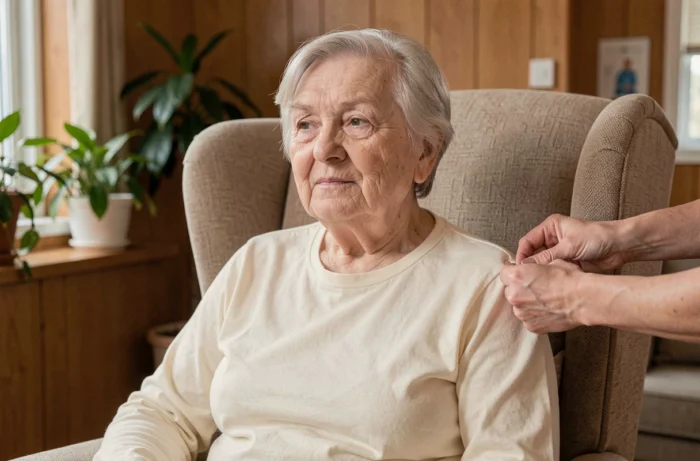
Textile composition of adult onesies: cotton, blend, or synthetic
Cotton remains the dominant material, valued for its softness and skin tolerance. A fabric with majority cotton withstands frequent washes at 60 °C, a temperature necessary to eliminate bacteria in the context of incontinence.
Cotton-polyester blends dry faster and wrinkle less. They are suitable for institutions managing large volumes of laundry. However, breathability decreases, which can cause excessive sweating in bedridden individuals.
The weight of the fabric plays a direct role in its lifespan. A fabric that is too thin (often chosen to reduce costs) deforms after a few dozen wash cycles. A sufficiently dense weight maintains the shape and fit of the garment over several months of daily use.
- 100% cotton: better skin tolerance, slower drying, suitable for fragile or reactive skin
- Cotton-polyester blend: quick drying, easier maintenance, less breathable
- Stretch jersey: a good compromise between comfort and support, provided that the elastane does not exceed a small proportion of the fabric
Checking the exact composition before purchase is even more relevant in the context of PFAS regulation, as some surface treatments applied to synthetic fibers are now prohibited. A simple fabric, without unnecessary treatment, often offers the best compromise between comfort, safety, and longevity.