
We clean a hardened brush after a day of work, and the first reflex is often to look for “a solvent” under the workbench. Acetone or white spirit, the two bottles look similar from a distance, but confusing them can damage a surface, slow down the job, or expose you to unnecessary fumes. Understanding what separates them is a way to save time and limit risks with each use.
Polar or non-polar solvent: what it changes on the job site
Acetone is a polar solvent. This means it dissolves resins, cyanoacrylate glues, nail polish, or polyurethane foam very well. White spirit, on the other hand, is a non-polar petroleum distillate: it targets fats, oils, and solvent-based paints (glycero, alkyd).
This distinction of polarity is not a laboratory detail. It determines which product works on which residue. Applying white spirit to a cyanoacrylate glue stain has almost no effect. Conversely, acetone does not dilute glycero paints and can even leave a whitish film on certain plastics.
For a more detailed acetone vs white spirit comparison on chemical composition, the technical data sheets for each product specify these material incompatibilities.
Acetone on resin and quick degreasing: concrete use cases
Acetone shines when you need a quick clean. Its evaporation is very fast, making it practical for degreasing a metal surface before welding, gluing, or applying a primer. It is also commonly used to clean tools after working with epoxy resin, provided you act before the resin fully polymerizes.
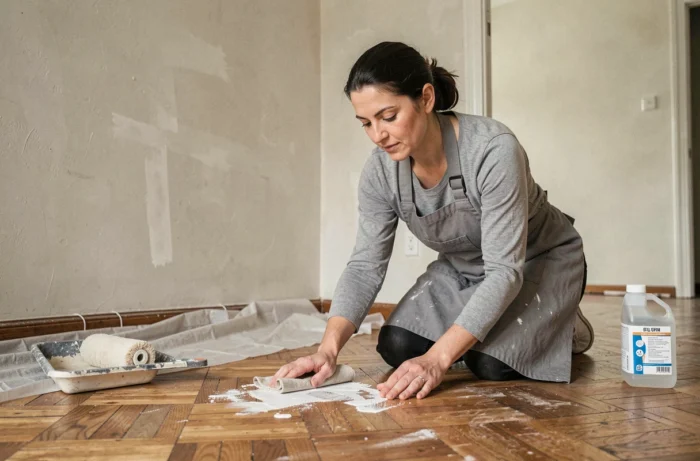
On a renovation site, it is also used to remove glue marks left by an old floor covering. A few seconds of contact is enough on most adhesives, then wipe with a clean cloth. The absence of a greasy film afterward is a clear advantage over white spirit.
However, acetone is aggressive on certain materials. Plastics like ABS or polycarbonate can deform or become cloudy upon contact. Before working on a plastic surface, always test in a less visible area.
White spirit for glycero paints and tool maintenance
White spirit remains the reference for diluting and cleaning anything related to oil-based paints, glyceryl phthalate lacquers, and greasy varnishes. Brushes and rollers are soaked in a bath of white spirit at the end of a session to keep them flexible. For spray painting work, it is also used to rinse the nozzle and the cup.
White spirit effectively dissolves mechanical greases, which explains its presence in almost all auto and motorcycle workshops. Chain cleaning, degreasing parts before reassembly: this is a common use.
Where it shows its limits is on acrylic (water-based) paints. It has no effect on them once dry. For water-based paint residues, a simple rinse with warm soapy water is sufficient as long as the paint has not fully hardened.
Usage precautions and solvent toxicity in enclosed spaces
Both products emit harmful vapors, but their risk profiles differ. Acetone is extremely flammable with a very low flash point. Any open flame, cigarette, or spark nearby poses a real danger. In return, its chronic toxicity is considered moderate compared to other organic solvents.
Classic white spirit (known as “aromatic”) contains aromatic hydrocarbons whose prolonged inhalation can irritate the respiratory tract and central nervous system. The persistent odor in poorly ventilated spaces is a warning signal not to be ignored.
Some precautions common to both products:
- Work in a ventilated area, ideally with cross ventilation or mechanical ventilation
- Wear nitrile gloves (latex degrades upon contact with acetone) and protective goggles
- Never pour used solvent down a sink or into nature, but dispose of it at a waste disposal site in a sealed container
- Store bottles away from heat and ignition sources, tightly closed
Feedback varies on the issue of masks: for occasional outdoor use, a filter cartridge mask A (organic vapors) is not always deemed necessary, but in confined spaces or repeated use, it is systematically recommended.
De-aromatized white spirit and REACH restrictions: where we are heading
The European regulatory framework is tightening on solvents containing substances classified as CMR (carcinogenic, mutagenic, or toxic for reproduction). The EU Council adopted a position in 2026 modifying entries 28, 29, and 30 of Annex XVII of the REACH regulation, with an entry into force scheduled for February 1, 2027.
In practice, this pushes manufacturers to offer de-aromatized white spirits with low VOC content. These versions are already available in DIY superstores. They are slightly less effective on very thick greases but are more than sufficient for cleaning brushes and diluting paints.
Acetone, which is not classified as CMR, is not directly affected by these restrictions. However, it remains subject to labeling rules related to its high flammability.
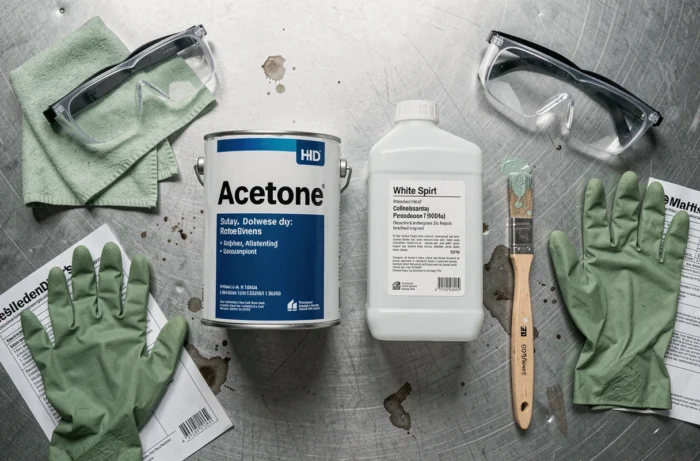
The choice between the two solvents often comes down to the type of residue to be treated: resin, glue, or quick degreasing points towards acetone, while glycero paints and mechanical greases call for white spirit. Keeping both bottles under the workbench, properly labeled and stored, remains the most pragmatic solution to cover the majority of job site situations.