You have just finished a painting job and your brushes are still sticky. Under the sink, two bottles are waiting: one of acetone, the other of white spirit. Which one to grab? The choice of solvent directly depends on the type of paint, the material to be treated, and the desired result. Confusing the two can damage a surface or make cleaning ineffective.
Solvent Polarity: The Key That Labels Don’t Explain
Before discussing usage, a simple concept deserves to be established. Acetone is a polar solvent, which means it mixes easily with water and dissolves water-based resins or synthetic glues. White spirit, on the other hand, is a non-polar solvent, derived from the distillation of petroleum. It behaves like an oil and dissolves what water cannot attack.
Why does this distinction matter when choosing? Because a polar solvent will not act on a glycerol paint (formulated with oils and alkyd resins). And a non-polar solvent will do nothing against a cyanoacrylate glue stain. Using the wrong product means scrubbing without results, or even spreading the problem.
To understand the difference between acetone and white spirit, you need to remember this principle of chemical compatibility: like dissolves like.
Acetone on Acrylic Paint and Resin: When to Use It
Acetone evaporates very quickly. This property makes it a precise ally when you want to clean without leaving an oily residue on the surface. Have you noticed that after using acetone, the surface dries almost instantly? It is this volatility that makes it useful for degreasing before applying paint or varnish.
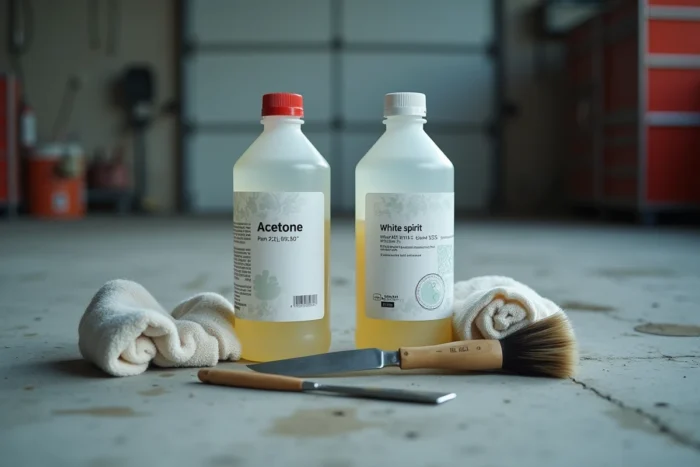
Here are the situations where acetone is the right choice:
- Cleaning brushes or rollers that have been used with dried acrylic paint, when water alone is no longer sufficient.
- Dissolving traces of epoxy resin or strong glue on metal or glass, two materials that withstand its action well.
- Degreasing a surface before gluing or painting, to ensure optimal adhesion without a greasy film.
On the other hand, acetone attacks many plastics. On polystyrene, plexiglass (PMMA), or certain ABS plastics, it causes softening or even partial dissolution. Before applying it to a synthetic material, always test on a hidden area. On raw wood, it penetrates quickly and can raise the fibers, necessitating sanding.
White Spirit for Glycerol Paint and Cleaning Oily Tools
White spirit is the natural partner for glycerol paints, oil varnishes, and solvent-based stains. When you dilute a glycerol paint that is too thick or clean a brush after a coat of lacquer, it is the appropriate product.
Its evaporation is slow compared to acetone. This pace allows time to work the paint (better film tension, fewer brush marks). This also explains its persistent odor and the need to ventilate the room for a long time after use.
White spirit does not dissolve glues or acrylic resins. However, it excels at removing tar stains from a car body, degreasing mechanical parts, or cleaning silicone sealant residues from tiles.
Beware of Acrylic Painted Surfaces
If you apply white spirit to a wall painted with acrylic, the solvent may dull the paint film without truly dissolving it. The result: an unsightly matte area. Acetone, in this specific case, will be more effective at removing a localized stain, provided you dab without scrubbing in wide movements.
Deodorized White Spirit: The Game-Changer in DIY
Classic white spirit contains aromatic hydrocarbons responsible for its strong odor and increased toxicity through inhalation. In recent years, manufacturers have offered deodorized versions, known as “odorless”, made from more purified petroleum cuts.
These substitutes retain the same solvent power on glycerol paints while significantly reducing exposure to volatile compounds. At most DIY retailers, deodorized white spirit has become the standard product on the shelf, while the classic version with high aromatic content is limited to professional or specialized uses.

This evolution follows European restrictions on volatile organic compounds (VOCs) in consumer products. Glycerol paints themselves are gradually being reformulated to limit their content of petroleum solvents. If you buy white spirit today for domestic work, always prefer the deodorized version: same effectiveness, lower respiratory risk.
Comparison Table: Acetone or White Spirit Depending on the Job
| Situation | Suitable Solvent | Why |
|---|---|---|
| Cleaning brush used with dried acrylic paint | Acetone | Dissolves hardened acrylic resins |
| Diluting glycerol paint | White spirit | Compatible with alkyd binders and oils |
| Degreasing metal before painting | Acetone | Fast evaporation, no greasy residue |
| Removing tar stain | White spirit | Dissolves heavy hydrocarbons |
| Cleaning epoxy resin | Acetone | Acts on non-polymerized resins |
| Maintaining wood stain | White spirit | Diluent recommended by manufacturers |
This table covers the most common cases in domestic DIY. For work on plastic, neither is a safe choice without prior testing: acetone attacks many polymers, and white spirit can leave a greasy film that is difficult to remove on certain synthetic surfaces.
The best reflex remains to read the technical data sheet of the paint or product to be treated. The manufacturer always indicates the recommended cleaning solvent, and this information avoids most mistakes. When no indication is available, test on a discreet area, wait a few minutes, and observe the material’s reaction before treating the entire surface.